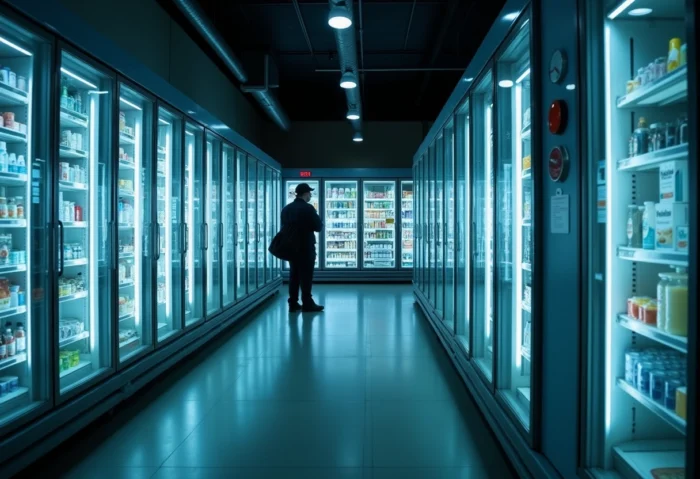
A cyberattack disrupted refrigeration systems at supermarkets in Belgium and several other European countries overnight from November 1 to 2. By remotely changing defrost settings, hackers raised the temperature in refrigerators and freezers, breaking the cold chain at some stores. For IT professionals, the incident shows that a network-connected device can become an entry point into an essential operation, even when it is not a desktop computer or a conventional server.
Refrigeration systems controlled remotely
In Belgium, refrigeration systems at Delhaize, Carrefour, Intermarché and Spar were affected. Delhaize reported that about 40 stores were impacted, while Carrefour reported 15. Stores operating under the Intermarché and Spar brands also reported disruptions. The totals may not include every affected business, and available reports sometimes distinguish confirmed incidents from anomalies whose cause is still being investigated.
Reports say the method involved remotely activating the defrost cycle. This function is normally used to remove frost from equipment, but an abnormal activation can send warm air into the units and raise their temperature. Similar incidents were reported on November 2 in nine European countries: Belgium, Estonia, Finland, Ireland, Italy, Luxembourg, the Netherlands, Portugal and Sweden. Sources do not establish that the same perpetrators were behind all of these cases.
The most immediate consequence concerns food. When temperatures no longer stay within the required range, affected stores have to remove products and sometimes discard fresh or frozen stock. In Belgium, some retailers also temporarily reduced their offerings. The federal prosecutor’s office has opened an investigation, but those responsible for the attack have not been identified.
Industrial equipment, but an IT risk
Refrigeration systems are technical systems controlled by equipment and, in some cases, monitored or managed remotely. This connectivity can help operators and technicians oversee the equipment, but it also means that security depends on how access is configured and protected. The incident in Belgium is a reminder that an operational system can have real consequences for business when a digital control is hijacked.
The problem is therefore not limited to data confidentiality or the unavailability of an online service. In this case, control of physical equipment affected the temperature and storage of goods. Cybersecurity is directly tied to business continuity and staff’s ability to check the condition of equipment. The incidents reported in Europe also raise a practical question: if remote monitoring stops working or sends abnormal commands, can staff still check temperatures and intervene?
Published reports do not describe all the technical systems used at the affected stores, and they do not establish that a single vulnerability explains every case. In Estonia, a supplier said hackers had accessed a control computer and raised the temperature setting. In Sweden, affected stores were connected to an external refrigeration control system. These details illustrate several possible routes to the equipment, without establishing a common method for every incident.
Safeguards to plan alongside operations
Experts quoted in news reports have pointed to steps to secure the systems, including physical modifications and the use of a secure internet connection. This highlights a challenge specific to connected industrial equipment: improving security may require work on the installation itself, not just a software update. Operators also need to know who can access the system, how access is controlled and how technicians can respond to an anomaly.
For a business, a useful check is to map connected equipment that controls critical functions, then clarify responsibilities among the store, the maintenance provider and the system supplier. It is also important to have a backup procedure: Who checks temperatures if remote control is unavailable? Who can disconnect an installation from the network, and how will operations continue during the intervention? These steps are part of general incident preparedness; they do not explain the current attack.
Available facts establish widespread disruption and product losses at some stores, but not the perpetrators’ identities or a confirmed link among all the affected countries. The Belgian investigation is ongoing. Until its findings are available, the incident is a reminder that cybersecurity for connected systems must include equipment that acts on the physical world, as well as procedures to maintain human oversight when its digital controls are compromised.