If you want a small iPhone in 2026, you have three real options, and none of them is on sale at Apple anymore: the iPhone SE (in one of its three generations), the iPhone 12 mini and the iPhone 13 mini. The smallest iPhone Apple ever made with a modern chip is the first iPhone SE, with a 4-inch screen and a weight of 113 grams. The smallest with an edge-to-edge display is the 12 mini, tied with the 13 mini.
Apple’s current lineup, as of late September 2026, starts at 6.1 inches. So the compact options all come from the used and refurbished market. The good news is that most of them still receive the latest iOS release.
What is the smallest iPhone?
By physical size, the iPhone SE (1st generation), released in March 2016, is the smallest of the models covered here: 123.8 mm tall, 58.6 mm wide and 113 grams. It borrows the iPhone 5s body. The iPhone 12 mini and 13 mini are a bit taller and wider, but they fit a much larger 5.4-inch screen into that footprint because they drop the home button and the thick bezels.
Here is how the small iPhones compare, with the current entry-level model for scale.
| Model | Screen | Dimensions (H x W x D) | Weight | Chip | Launch price (US) |
|---|---|---|---|---|---|
| iPhone SE (1st gen, 2016) | 4.0-inch LCD | 123.8 x 58.6 x 7.6 mm | 113 g | A9 | $399 |
| iPhone SE (2nd gen, 2020) | 4.7-inch LCD | 138.4 x 67.3 x 7.3 mm | 148 g | A13 Bionic | $399 |
| iPhone SE (3rd gen, 2022) | 4.7-inch LCD | 138.4 x 67.3 x 7.3 mm | 144 g | A15 Bionic | $429 |
| iPhone 12 mini (2020) | 5.4-inch OLED | 131.5 x 64.2 x 7.4 mm | 135 g | A14 Bionic | $699 |
| iPhone 13 mini (2021) | 5.4-inch OLED | 131.5 x 64.2 x 7.65 mm | 141 g | A15 Bionic | $699 |
| iPhone 17e (2026, for reference) | 6.1-inch OLED | 146.7 x 71.5 x 7.8 mm | 169 g | A19 | $599 |
A note on the iPhone 12 mini and iPhone 12 prices: Apple advertised $699 and $799 with a $30 carrier discount on AT&T and Verizon. The SIM-free versions started at $729 and $829.
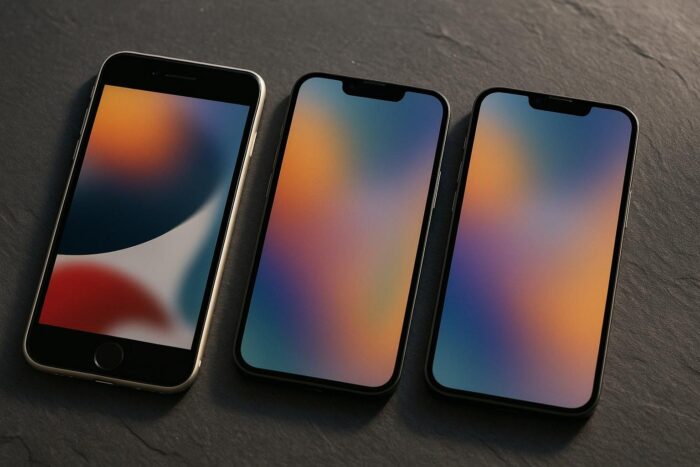
Screen size alone can be misleading. The 4.7-inch SE models have a 16:9 LCD surrounded by thick bezels, while the 5.4-inch minis use a taller OLED panel that runs almost to the edges. In the hand, the minis feel smaller than the 2020 and 2022 SE, yet they show more content on screen. The first SE is the only one that is smaller in every dimension.
iPhone SE: the smallest body, with an older design
The SE line was Apple’s way of putting a recent chip inside an older, cheaper shell. Three generations came out, and they are quite different when it comes to size.
The first model, from 2016, is the one people picture when they talk about a truly pocketable iPhone. Its 4-inch screen (1136 x 640 pixels) feels cramped by today’s standards, and its A9 chip stopped getting new iOS versions after iOS 15. It is a collector’s item or a backup phone, not a daily driver in 2026.
The 2020 and 2022 models share the iPhone 8 body: a 4.7-inch LCD, a Touch ID home button and wide bezels above and below the screen. They are taller than the 12 mini, yet their screen is smaller. What they offer instead is Touch ID, a familiar layout and a lower price on the used market. The 2022 model adds the A15 Bionic and 5G. For the whole story of each generation, see our full page on Apple’s iPhone SE, which covers specs, prices and what replaced it.
Apple stopped selling the third-generation SE on February 19, 2025, when it announced the iPhone 16e. That phone has a 6.1-inch screen, so the SE name ended with no small successor.
iPhone 12 mini: the first modern mini
Released on November 13, 2020, the iPhone 12 mini brought the full iPhone 12 experience to a 5.4-inch OLED screen: Face ID, the A14 Bionic, 5G, Ceramic Shield, IP68 water resistance and a dual 12MP camera (wide and ultra wide). At 131.5 mm tall and 135 grams, it is one of the easiest iPhones to use with one hand.
The trade-off is battery life. Apple rates it at up to 15 hours of video playback, against 17 hours for the regular iPhone 12, and reviewers at launch pointed to it as the weak point. MagSafe charging is also capped at 12W on the mini models. Apple cut its price to $599 in September 2021 and discontinued it in September 2022.
iPhone 13 mini: the last and best small iPhone
The iPhone 13 mini, released on September 24, 2021 at $699, keeps the same height and width as the 12 mini. It is slightly thicker (7.65 mm) and heavier (141 g), and that extra room went into the battery: Apple quotes up to 17 hours of video playback, two more than the 12 mini. It also gets the A15 Bionic, a smaller notch, and starts at 128GB of storage instead of 64GB.
Apple discontinued it on September 12, 2023, and no mini model has followed. If you want the most capable compact iPhone with a full-screen design, this is it.
Which small iPhone should you choose?
Software support matters more than specs for a phone you plan to keep. Every model in the table except the first SE runs iOS 27, which Apple released on September 14, 2026 for the iPhone 11 and later, including the iPhone SE (2nd generation and later). None of the SE or mini models supports Apple Intelligence, though, and the new Siri features in iOS 27 require an iPhone 15 Pro or newer.
- Best overall small iPhone: the iPhone 13 mini. Newest chip of the minis, best battery, 128GB base storage.
- Cheapest compact option: the iPhone SE (3rd generation), if you like Touch ID and don’t mind the bezels.
- Smallest screen you can still use daily: the iPhone 12 mini, which shares the 13 mini’s 5.4-inch screen, if you find one with a healthy battery. Check the battery health figure in Settings before buying, since these phones are now five to six years old.
- Smallest iPhone ever: the first iPhone SE, best kept as a spare or a music player given its iOS 15 limit.
When buying used, check the battery health, ask whether the battery or screen was replaced with genuine parts, and confirm the phone is not locked to a carrier or to someone’s Apple Account.
Does Apple still sell a small iPhone?
No. The lineup Apple lists in late September 2026 includes the iPhone 17e and iPhone 16 (both 6.1 inches), the iPhone 17 (6.3 inches), the iPhone Air (6.5 inches), the iPhone 18 Pro and Pro Max, and the new iPhone Duo. The Duo has a 5.4-inch outer screen, the same diagonal as the minis, but it is a foldable that weighs 254 grams and starts at $1,999. It is not a small phone in the sense mini fans mean.
The lightest non-foldable model Apple sells right now is the iPhone Air, at 165 grams, and the most compact is the iPhone 17e. Both are noticeably larger than any mini or SE.
FAQ
Is the iPhone 13 mini smaller than the iPhone SE?
It is shorter and narrower than the 2020 and 2022 iPhone SE (131.5 x 64.2 mm vs 138.4 x 67.3 mm) while offering a bigger 5.4-inch screen. Only the 2016 iPhone SE is smaller.
Do the iPhone 12 mini and 13 mini have the same size?
Almost. Height and width are identical. The 13 mini is 0.25 mm thicker and 6 grams heavier. Many cases fit both, but a model-specific case is the safer choice because the camera bumps differ.
Will Apple release a new mini iPhone?
Apple has not announced one. Since the 13 mini, every new iPhone has had a screen of at least 6.1 inches, except the cover screen of the foldable iPhone Duo.
Which small iPhones still get updates?
The iPhone 12 mini, iPhone 13 mini and iPhone SE (2nd and 3rd generation) all support iOS 27. The original 2016 iPhone SE stopped at iOS 15.