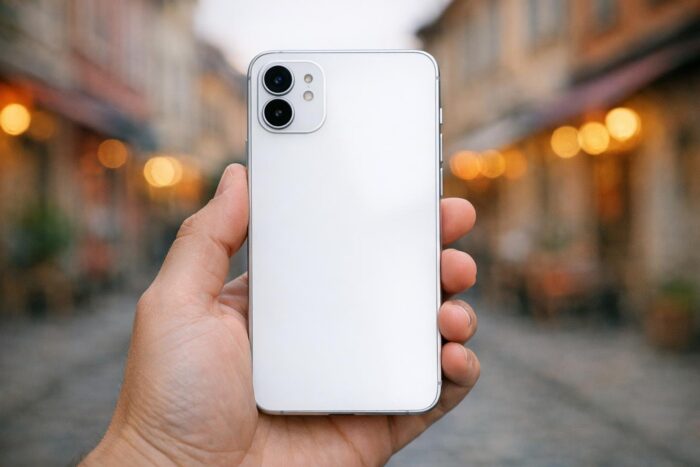
The iPhone 17 camera system pairs two 48MP rear cameras, a main camera and an ultra wide, with a new 18MP Center Stage front camera. That is a clear step up from the iPhone 16, whose ultra wide and selfie cameras were both 12MP, and it makes the standard model the best-equipped non-Pro iPhone for photos and video.
The iPhone 17e, Apple’s entry model since March 2026, keeps the same 48MP main camera resolution but drops the ultra wide and goes back to a 12MP front camera. Here is what each camera does, what the video side offers, and where the 17e falls short.
iPhone 17 camera specs at a glance
Figures below come from Apple’s official technical specifications for both phones.
| Camera | iPhone 17 | iPhone 17e |
|---|---|---|
| Main | 48MP Fusion, 26 mm, f/1.6, sensor-shift stabilization | 48MP Fusion, 26 mm, f/1.6, optical stabilization |
| 2x telephoto (from main sensor) | 12MP, 52 mm | 12MP, 52 mm |
| Ultra wide | 48MP Fusion, 13 mm, f/2.2, 120° field of view | None |
| Optical zoom range | 2x in, 2x out | 2x in |
| Digital zoom (photo) | Up to 10x | Up to 10x |
| Front camera | 18MP Center Stage, f/1.9, autofocus | 12MP TrueDepth, f/1.9 |
| Best 4K video | 4K Dolby Vision at 60 fps | 4K Dolby Vision at 60 fps |
| Camera Control button | Yes | No |
The 48MP Fusion main camera
The main camera sits behind a 26 mm lens with a bright f/1.6 aperture. By default it combines pixels to produce 24MP photos, a balance between detail and file size, and it can shoot full 48MP images when you want to crop later. Sensor-shift stabilization moves the sensor itself to counter hand shake, which helps in low light and when filming on the move.
The “2x telephoto” is not a separate lens. The phone crops the center of the 48MP sensor to deliver a 12MP image at a 52 mm equivalent, which Apple calls optical quality. For portraits and street scenes it works well; beyond 2x, you are into digital zoom.
The ultra wide camera, now 48MP
This is the biggest change from the iPhone 16. The 13 mm ultra wide now uses a 48MP sensor with a 120° field of view. Wide landscapes, tight interiors and group shots gain detail, and the same camera handles macro photography, with 48MP macro shots listed in Apple’s specs. Together with the main camera, it gives a 4x optical zoom range, from 0.5x to 2x.
The 18MP Center Stage selfie camera
The front camera gets the most noticeable redesign. Its square 18MP sensor lets the phone widen the frame automatically when more people step into a selfie, and you can shoot horizontal selfies while holding the phone upright. It has autofocus and an f/1.9 aperture. The same Center Stage idea keeps you centered during video calls.
A related feature, Dual Capture, records with the front and rear cameras at the same time, up to 4K Dolby Vision at 30 fps, handy for reaction videos or vlogging.
Video on the iPhone 17
- 4K Dolby Vision at 24, 25, 30 or 60 fps
- Cinematic mode up to 4K Dolby Vision at 30 fps, with focus changes after shooting
- Action mode up to 2.8K at 60 fps for very shaky footage
- Slo-mo at 1080p, 120 or 240 fps
- Spatial video at 1080p, 30 fps, for viewing on Apple Vision Pro
- Audio Mix and Spatial Audio recording
What it does not have: 4K at 120 fps, ProRes and Log recording remain exclusive to the Pro models. For family video, travel clips and social media, the standard model covers nearly everything. You can see how the camera fits with the rest of the hardware in our full breakdown of the standard model and its 120Hz display.
Camera Control
The iPhone 17 has the Camera Control button on its right edge. A press opens the camera from any screen, a second press takes the photo, and a light press and slide adjusts zoom or exposure without touching the screen. It is useful when shooting one-handed or in bright sunlight.
What the iPhone 17e keeps and what it loses
The 17e is built around the same main camera specification: 48MP, 26 mm, f/1.6, with the 2x crop and 4K Dolby Vision at up to 60 fps. In good light, everyday photos from the rear camera are where the two phones are closest.
The gaps show up elsewhere:
- No ultra wide. You cannot zoom out to 0.5x, and there is no macro mode.
- Older selfie camera. 12MP TrueDepth without Center Stage framing.
- Fewer video modes. Apple’s spec sheet for the 17e does not list Cinematic mode, Action mode, Dual Capture or spatial video.
- No Camera Control. The 17e has an Action button you can assign to the camera instead.
Price is the counterweight. In October 2026 Apple sells the 17e from $699 for 256GB, against $899 for the iPhone 17 with carrier activation, or $929 unlocked. If photos are mostly of people and scenes in front of you, the 17e is enough; anyone who uses the 0.5x lens or films a lot will miss the extras. Our hub page on Apple’s entry-level model and who it suits compares the rest of its features.
FAQ
How many cameras does the iPhone 17 have?
Three: a 48MP main camera and a 48MP ultra wide on the back, and an 18MP Center Stage camera on the front.
Does the iPhone 17 have a telephoto lens?
No dedicated one. Its 2x zoom is a 12MP crop from the main 48MP sensor. A real telephoto lens is reserved for the Pro models.
Can the iPhone 17 record 4K at 120 fps?
No. It records 4K Dolby Vision at up to 60 fps. 4K at 120 fps is a Pro feature.
Is the iPhone 17e camera the same as the iPhone 17?
Only the main rear camera shares the same core specification. The 17e has no ultra wide, a 12MP selfie camera and fewer video modes.