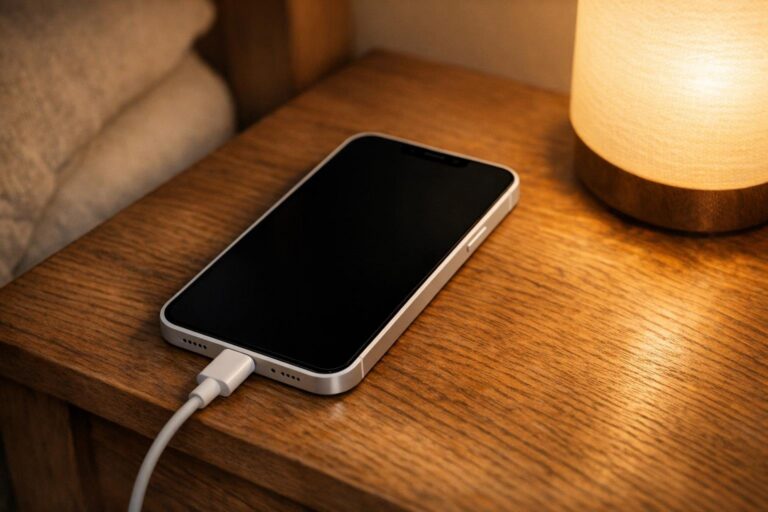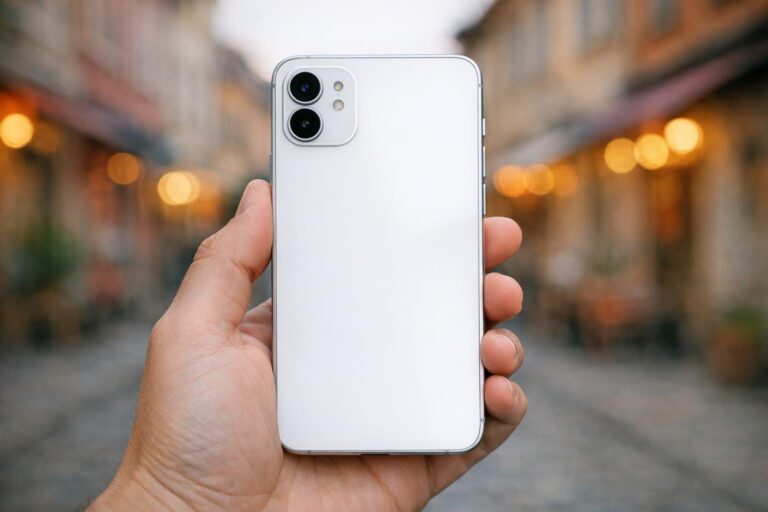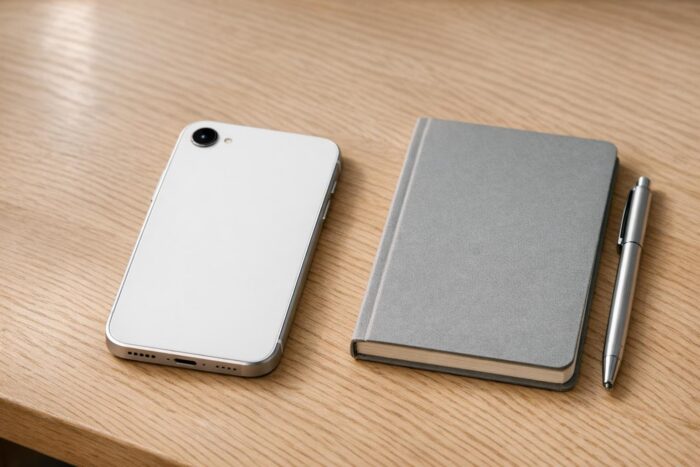
The iPhone 17e is Apple’s entry-level iPhone, announced on March 2, 2026 and released on March 11, 2026. It replaces the iPhone 16e and keeps the same recipe: a 6.1-inch OLED screen, a single 48MP camera and a current-generation chip, here the A19, in a simpler aluminum body that costs far less than the flagship models.
It launched at $599 with 256GB of storage, double the base storage of the 16e at the same price. On September 9, 2026, Apple raised the price of its older models, and in October 2026 the iPhone 17e is listed at $699 (256GB) and $899 (512GB) on Apple’s US store. That is still the lowest price of any iPhone Apple sells new.
This guide covers everything that matters before you buy: price history, full specs, size, battery life, camera, storage, who should pick it, and how it stacks up against the iPhone 17, the iPhone Air and the rest of the current lineup.
iPhone 17e at a glance
If you only want the short version, here it is. The 17e is a 6.1-inch iPhone with the same A19 chip family as the iPhone 17, Apple’s own C1X cellular modem, MagSafe charging and an IP68 rating. What it gives up compared with pricier models: a notch instead of the Dynamic Island, a 60Hz display without ProMotion, a single rear camera with no ultra wide lens, no Camera Control button and older Wi-Fi 6.
- Announced: March 2, 2026
- Pre-orders: March 4, 2026
- Released: March 11, 2026
- Launch price: $599 for 256GB
- Price in October 2026: $699 for 256GB, $899 for 512GB (Apple US store)
- Colors: Black, White and Soft Pink, all with a matte finish
- Software at launch: iOS 26, now updated to iOS 27
Where the iPhone 17e fits in Apple’s lineup
The “e” models are Apple’s budget line. The iPhone 16e arrived in February 2025 as the successor to the iPhone SE, and the 17e followed a year later. Apple stopped selling the 16e the day the 17e was announced, so the 17e is now the only “e” iPhone in the lineup.
It is worth situating the phone correctly, because the iPhone family has moved since March. In September 2026 Apple introduced the iPhone 18 Pro, the iPhone 18 Pro Max and the iPhone Duo, and it discontinued the iPhone 17 Pro and 17 Pro Max. In October 2026, Apple’s US lineup reads as follows:
| Model | Starting price (Apple US, October 2026) | Role in the lineup |
|---|---|---|
| iPhone 16 | $799 (with carrier activation), $829 unlocked | Older standard model, 128GB base |
| iPhone 17e | $699 | Entry-level, current chip |
| iPhone 17 | $899 (with carrier activation), $929 unlocked | Standard model |
| iPhone Air | $1,099 | Ultra-thin 6.5-inch model |
| iPhone 18 Pro | $1,199 | Current Pro model |
| iPhone Duo | $1,999 | Top of the range |
The 17e is the cheapest way to get an A19-class chip, Apple Intelligence support and a 2026 design from Apple’s current generation. Oddly, the older iPhone 16 now costs more than the 17e while starting with half the storage, which makes the 16 hard to recommend over it.
iPhone 17e price: launch, increase and what you get per dollar
At launch the 17e cost exactly what the 16e did, $599, but with 256GB instead of 128GB. Apple’s September 2026 increase added $100 to the iPhone 16, the 17e, the iPhone 17 and the iPhone Air, with no hardware change. Coverage of the move tied it to rising memory and storage costs.
| Capacity | Launch price (March 2026) | Apple US price (October 2026) |
|---|---|---|
| 256GB | $599 | $699 |
| 512GB | Not confirmed by Apple’s announcement | $899 |
Even after the increase, the 17e remains $200 below the iPhone 17 bought with carrier activation and $230 below the unlocked iPhone 17. The real question is whether the features you lose are worth that gap, which we cover below.
Full iPhone 17e specs
The figures below come from Apple’s technical specifications page.
| Spec | iPhone 17e |
|---|---|
| Display | 6.1-inch Super Retina XDR OLED, 2532 x 1170 at 460 ppi, notch |
| Brightness | 800 nits typical, 1200 nits peak HDR |
| Front glass | Ceramic Shield 2 |
| Chip | A19, 6-core CPU, 4-core GPU with Neural Accelerators, 16-core Neural Engine |
| Modem | Apple C1X, 5G (sub-6 GHz) |
| Wireless | Wi-Fi 6, Bluetooth 5.3, NFC |
| Rear camera | 48MP Fusion, f/1.6, optical image stabilization, 2x optical-quality telephoto crop |
| Front camera | 12MP TrueDepth, f/1.9 |
| Video playback | Up to 26 hours (21 hours streamed) |
| Charging | USB-C, 50% in about 30 minutes with a 20W adapter; MagSafe and Qi2 up to 15W |
| Port | USB-C, USB 2 speeds (480 Mb/s) |
| Storage | 256GB or 512GB |
| SIM | eSIM only in the US |
| Durability | IP68 (6 meters for up to 30 minutes) |
| Buttons | Action button, side button, volume buttons |
| Security | Face ID |
Two details stand out. The A19 in the 17e has one fewer GPU core than the A19 in the iPhone 17 (four instead of five), the same kind of trim Apple applied to the 16e. And the C1X modem is Apple’s second in-house modem: Apple says it is up to twice as fast as the C1 in the 16e and uses 30% less energy than the modem in the iPhone 16 Pro.
Size, weight and design
The 17e measures 146.7 x 71.5 x 7.80 mm and weighs 169 g. It is the most compact phone in Apple’s current lineup, slightly shorter than the 6.3-inch iPhone 17 (149.6 mm tall, 177 g) and much smaller than the 6.5-inch iPhone Air (156.2 mm tall), although the Air is thinner at 5.64 mm and a little lighter at 165 g.
The body is aluminum with a glass back. The front uses Ceramic Shield 2, which Apple says resists scratches three times better than the previous generation. Instead of the Dynamic Island, the 17e keeps a notch at the top of the screen to house the Face ID sensors. In daily use that mostly means you don’t get live activities in a pill-shaped area at the top; notifications and live activities still appear on the Lock Screen.
The 17e has the Action button on the left side, which you can assign to the camera, the flashlight, a Focus mode, Visual Intelligence, translation or a shortcut. It does not have the Camera Control button found on the iPhone 17 and the Air.
Display: good panel, no ProMotion
The screen is a 6.1-inch OLED with the same resolution as the 16e. Colors, contrast and HDR playback are what you expect from an Apple OLED panel. Peak brightness is 1200 nits for HDR content, below the 1600 nits HDR and 3000 nits outdoor peak of the iPhone 17 and the Air.
The main difference you will notice is motion. The iPhone 17 and iPhone Air have ProMotion with refresh rates up to 120Hz and an Always-On display. The 17e has neither, so scrolling looks less fluid side by side, and the screen turns off when the phone is locked. If you have never used a 120Hz phone, this is easy to live with. If you are coming from one, you will see it.
Performance: the A19 chip
The A19 is built on a 3nm process with a 6-core CPU (two performance cores, four efficiency cores), a 4-core GPU with Neural Accelerators and a 16-core Neural Engine. The GPU also supports hardware ray tracing in games that use it. Apple compares the CPU with the iPhone 11 and says it is up to twice as fast, which gives an idea of the gain for anyone keeping a phone for five or six years.
In practice, the 17e has the same generation of chip as the iPhone 17, so apps, photo processing and Apple Intelligence features run on current silicon rather than on a chip from a previous year. The one-core GPU difference matters mostly for demanding 3D games played for long sessions.
iPhone 17e battery life and charging
Apple rates the 17e for up to 26 hours of local video playback and up to 21 hours of streamed video. That matches the 16e’s video playback rating, with the same 4,005 mAh battery listed for both phones. The 17e holds that level while switching to a more efficient modem.
| Model | Video playback (Apple) | Streamed video (Apple) |
|---|---|---|
| iPhone 17e | Up to 26 hours | Up to 21 hours |
| iPhone 16e | Up to 26 hours | Not compared here |
| iPhone 17 | Up to 30 hours | Up to 27 hours |
| iPhone Air | Up to 27 hours | Up to 22 hours |
Charging is where the 17e improves most on its predecessor. The 16e had no MagSafe and only 7.5W Qi charging. The 17e supports MagSafe and Qi2 up to 15W, so magnetic chargers, wallets and stands now snap on. Wired charging reaches about 50% in 30 minutes with a 20W adapter or higher; the iPhone 17 is faster, at 50% in about 20 minutes with a 40W adapter and up to 25W wireless.
Camera: one lens, used well
The rear camera is a single 48MP Fusion camera with an f/1.6 aperture and optical image stabilization. By using the center of the 48MP sensor, it produces 12MP photos at 2x that Apple calls optical quality, so you get a usable portrait-length zoom without a second lens. Digital zoom goes up to 10x. Video reaches 4K Dolby Vision at up to 60 fps, with Night mode, Portrait mode, Smart HDR 5 and Photographic Styles on the photo side.
What you don’t get: an ultra wide lens (and therefore macro photography and spatial photos), Cinematic mode and Action mode. The front camera is a 12MP TrueDepth unit, while the iPhone 17 and the Air move to an 18MP Center Stage front camera that can widen the frame for group selfies. The camera hardware is essentially the same as on the 16e, and reviewers have counted it among the phone’s weaker points relative to its price.
Storage: 256GB is the right default
With 256GB as the base capacity, the 17e no longer forces a paid upgrade the way the 128GB 16e did. For most people who use iCloud for photo backup, 256GB leaves comfortable room for apps, offline music and a few years of photos. The 512GB model, at $899 in October 2026, makes sense if you shoot a lot of 4K video or keep large offline libraries, but at that price the 256GB iPhone 17 becomes a serious alternative.
iPhone 17e vs iPhone 17, iPhone Air and iPhone 16e
Here is how the 17e compares with its closest siblings, using Apple’s published specs.
| iPhone 17e | iPhone 17 | iPhone Air | iPhone 16e | |
|---|---|---|---|---|
| Screen | 6.1-inch, notch, 60Hz | 6.3-inch, Dynamic Island, 120Hz | 6.5-inch, Dynamic Island, 120Hz | 6.1-inch, notch, 60Hz |
| Chip | A19 (4-core GPU) | A19 (5-core GPU) | A19 Pro (5-core GPU) | A18 (4-core GPU) |
| Rear cameras | 48MP main | 48MP main + 48MP ultra wide | 48MP main | 48MP main |
| Front camera | 12MP | 18MP Center Stage | 18MP Center Stage | 12MP |
| Wireless charging | MagSafe, 15W | MagSafe, 25W | MagSafe, 20W | Qi, 7.5W |
| Wi-Fi | Wi-Fi 6 | Wi-Fi 7 | Wi-Fi 7 | Wi-Fi 6 |
| Weight | 169 g | 177 g | 165 g | 167 g |
| Base storage | 256GB | 256GB | 256GB | 128GB |
Against the iPhone 17
The iPhone 17 is the upgrade most people should weigh. For $200 to $230 more, you get a bigger 120Hz screen with the Dynamic Island and Always-On mode, a second 48MP ultra wide camera, a better selfie camera, Camera Control, faster wired and wireless charging, longer rated battery life and Wi-Fi 7. If you keep phones for years and care about photos or screen smoothness, that is a lot for the money.
Against the iPhone Air
The Air also has a single rear camera, but it pairs it with a 6.5-inch ProMotion display, the A19 Pro chip and a titanium frame only 5.64 mm thick. It costs $400 more than the 17e in October 2026. Choose it for the design and the big screen, not for the camera.
Against the iPhone 16e
Same size, same screen, same camera hardware. The 17e brings the A19 chip, the faster C1X modem, MagSafe, a tougher front cover and double the base storage. If you already own a 16e, there is little reason to upgrade; if you are buying now, the 17e is the one Apple sells.
Who should buy the iPhone 17e?
The 17e makes the most sense for:
- People moving from an iPhone 11, 12 or an iPhone SE who want a current chip and long software support without paying flagship prices.
- Buyers who mostly use their phone for messaging, browsing, maps, streaming and casual photos.
- Parents choosing a first iPhone for a teenager, or anyone who wants a solid second phone.
- Users who prefer a compact phone: it is the smallest model in Apple’s current lineup.
It is a weaker fit if you take lots of photos of landscapes or interiors (no ultra wide), if you are used to a 120Hz screen, or if you play demanding games for hours. In those cases the iPhone 17 is the better long-term buy, even at the higher price.
Software support and features
The 17e shipped with iOS 26 and now runs iOS 27, the version Apple released in the fall of 2026. With an A19 chip and 2026 hardware, it should stay supported for many years; Apple does not publish a fixed number of years, so treat any precise end date you read as a guess. The phone supports Apple Intelligence, Visual Intelligence through the Action button, and Apple’s satellite features (Emergency SOS, Roadside Assistance, Messages and Find My via satellite), included free for two years after activation. It is eSIM only in the US.
iPhone 17e FAQ
When did the iPhone 17e come out?
Apple announced it on March 2, 2026. Pre-orders opened on March 4 and the phone went on sale on March 11, 2026.
How much does the iPhone 17e cost?
It launched at $599 for 256GB. Since Apple’s September 2026 price increase, it costs $699 for 256GB and $899 for 512GB on Apple’s US store (October 2026).
Does the iPhone 17e have the Dynamic Island?
No. It keeps a notch at the top of the 6.1-inch screen, like the 16e. The Dynamic Island is on the iPhone 17, the iPhone Air and the Pro models.
Does the iPhone 17e support MagSafe?
Yes. Unlike the 16e, it supports MagSafe and Qi2 wireless charging at up to 15W, along with magnetic accessories.