The iPhone 17 is Apple’s standard model, and in October 2026 it sits right above the cheaper iPhone 17e in the lineup. Both run the A19 chip and both start with 256GB of storage, so the question is simple: what does the extra money actually pay for?
Short answer: a smoother and brighter 120Hz display, a second 48MP camera for ultra wide shots, a sharper Center Stage selfie camera, a slightly faster GPU, faster charging and longer battery life. For many buyers, that is the best value in Apple’s current range. For others, the 17e covers everything they need.
The iPhone 17 at a glance
Apple announced the iPhone 17 on September 9, 2025, alongside the iPhone Air and the iPhone 17 Pro models. Pre-orders opened on September 12 and the phone reached stores on September 19, 2025. It launched at $799 with 256GB, double the base storage of the iPhone 16 it replaced at the top of the regular line.
A year later, the picture changed. On September 9, 2026, the day it unveiled the iPhone 18 Pro, Apple raised the price of several existing models by $100 and discontinued the iPhone 17 Pro and 17 Pro Max. In October 2026, Apple’s US store lists the iPhone 17 from $899 for 256GB. That figure includes a $30 connectivity discount tied to activation with a major carrier at purchase; bought unlocked to connect later, it costs $929, and the 512GB version costs $1,129.
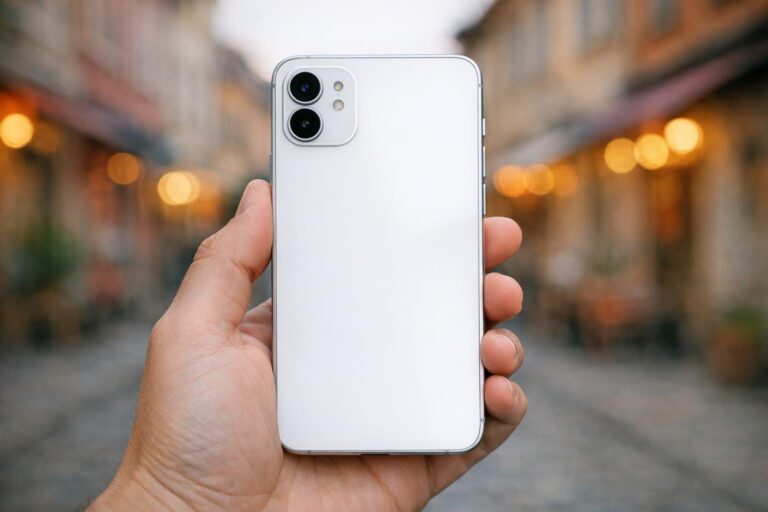
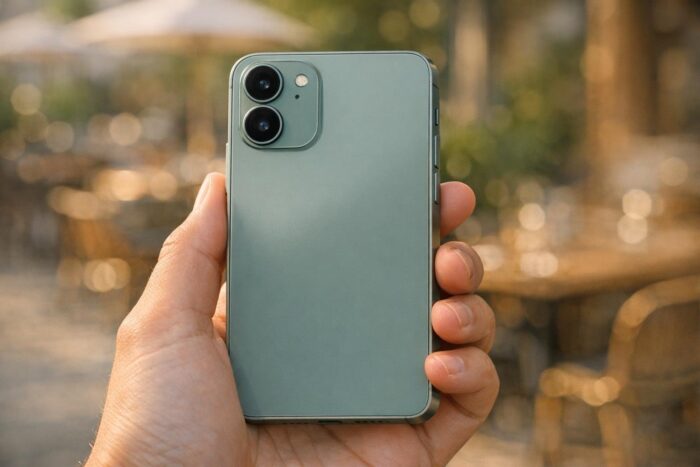
The new base model kept the familiar flat-edged aluminum design and comes in five colors: black, white, mist blue, sage and lavender.
iPhone 17 vs iPhone 17e: the spec gap in one table
The iPhone 17e arrived on March 11, 2026, at $599, and now starts at $699 after the September 2026 increase. That leaves a $200 gap with the iPhone 17 when you compare like for like with carrier activation, or $230 if you buy both unlocked. Here is what the two phones look like side by side, according to Apple’s official specs.
| Spec | iPhone 17 | iPhone 17e |
|---|---|---|
| Starting price (Oct. 2026) | $899 with carrier activation, $929 unlocked | $699 |
| Display | 6.3-inch OLED, ProMotion up to 120Hz | 6.1-inch OLED, no ProMotion |
| Brightness | 1000 nits typical, 3000 nits peak outdoors | 800 nits typical, 1200 nits peak (HDR) |
| Chip | A19, 6-core CPU, 5-core GPU | A19, 6-core CPU, 4-core GPU |
| Rear cameras | 48MP Fusion Main + 48MP Fusion Ultra Wide | 48MP Fusion Main only |
| Front camera | 18MP Center Stage | 12MP TrueDepth |
| Video playback | Up to 30 hours | Up to 26 hours |
| Wired charging | 50% in 20 min (40W adapter) | 50% in 30 min (20W adapter) |
| MagSafe / Qi2 | Up to 25W | Up to 15W |
| Wireless chip | Apple N1, Wi-Fi 7 | Wi-Fi 6 |
| Camera Control, Dynamic Island | Yes | No |
| Storage | 256GB, 512GB | 256GB, 512GB |
| Weight | 177 g | 169 g |
What the extra money buys
A 120Hz display that finally matches the Pro feel
For years, Apple kept ProMotion for its Pro phones. The iPhone 17 is the first standard model to get it, with an adaptive refresh rate up to 120Hz and an Always-On display. Scrolling, swiping between apps and games all feel noticeably smoother. The panel is also bigger at 6.3 inches and much brighter outdoors, rated at 3000 nits peak in sunlight versus 1200 nits HDR peak on the 17e. Ceramic Shield 2 on the front adds better scratch resistance and an anti-reflective coating.
The 17e’s screen is a good OLED panel, but next to the iPhone 17 it is the most visible difference in daily use.
A second 48MP camera
The iPhone 17 pairs its 48MP Fusion main camera with a 48MP Fusion Ultra Wide. The 17e has a single 48MP rear camera. Both can produce an optical-quality 2x crop from the main sensor, but only the iPhone 17 can pull back for wide landscapes, tight rooms or group shots. Neither phone has a true telephoto lens; that remains a Pro feature.
On the front, the iPhone 17 gets an 18MP Center Stage camera. You can take a horizontal selfie while holding the phone upright, and the frame widens automatically when more people step in. It also supports Dual Capture, recording from the front and rear cameras at once. The 17e keeps a conventional 12MP TrueDepth camera.
The same chip, with one more GPU core
Both phones use the A19, built on a third-generation 3-nanometer process, and both run Apple Intelligence. The difference is in graphics: the iPhone 17 has a 5-core GPU, the 17e a 4-core one. For messaging, photos and streaming, you will not feel it. For demanding games and long video edits, the iPhone 17 has more headroom.
Battery and charging
Apple rates the iPhone 17 at up to 30 hours of video playback, four more than the 17e. Charging is also quicker: up to 50% in 20 minutes with a 40W or higher USB-C adapter, and up to 25W with MagSafe or Qi2. The 17e reaches 50% in 30 minutes with a 20W adapter and tops out at 15W wirelessly. Both use a USB-C port at USB 2 speeds.
Smaller extras
The iPhone 17 adds Camera Control, the capacitive button for launching and adjusting the camera, plus the Dynamic Island. It uses Apple’s N1 wireless chip for Wi-Fi 7, Bluetooth 6 and Thread, while the 17e sticks to Wi-Fi 6. Both phones have the Action button and an IP68 rating.
Where the iPhone 17e holds its ground
The cheaper phone is not a cut-down toy. It shares the A19 chip, 256GB base storage, MagSafe support, the Action button, Apple Intelligence and the same water resistance rating. It is also a little smaller and lighter, at 146.7 mm tall and 169 g, against 149.6 mm and 177 g for the iPhone 17.
If your phone is mostly for calls, messages, social apps, maps and casual photos, the 17e does the job, and the $200 saved can go toward a case, AppleCare or simply stay in your pocket.
Is the iPhone 17 base model worth it?
For most people buying a new iPhone in late 2026, yes. The screen alone changes the daily experience, the ultra wide camera adds real flexibility, and the longer battery life and faster charging remove small frictions. Published reviews at launch generally called it the best value in Apple’s lineup, while pointing out that it still lacks a dedicated telephoto lens and that its design barely changed from the iPhone 16.
Choose the iPhone 17 if you:
- notice and care about smooth scrolling and an outdoor-friendly screen;
- shoot landscapes, interiors or group photos that need an ultra wide lens;
- take a lot of selfies or video calls;
- play games or keep a phone four or five years and want extra headroom.
Choose the iPhone 17e if you:
- want the cheapest new iPhone with Apple Intelligence and 256GB;
- use one camera for almost everything;
- prefer a slightly smaller, lighter phone;
- are buying for a teen, a parent or as a second line.
If you want even more, the next step up is the iPhone Air at $1,099, then the iPhone 18 Pro at $1,199. Those jumps buy thinness or a telephoto camera, not the everyday improvements that make the iPhone 17 such an easy recommendation over the 17e.
FAQ
How much is the iPhone 17 in October 2026?
Apple’s US store lists it from $899 for 256GB with carrier activation at purchase, or $929 unlocked. The 512GB model costs $1,129 unlocked. It launched at $799 in September 2025.
Is the iPhone 17 the base model?
It is the standard model of the iPhone 17 family. The iPhone 17e sits below it as the entry-level option, while the Air and the Pro models sit above.
Does the iPhone 17 have a 120Hz screen?
Yes. It is the first non-Pro iPhone with ProMotion, adapting up to 120Hz, and it supports an Always-On display. The iPhone 17e does not have ProMotion.
Do the iPhone 17 and 17e have the same chip?
Both use the A19, but the iPhone 17 has a 5-core GPU and the 17e a 4-core GPU. Everyday speed is similar; graphics-heavy tasks favor the iPhone 17.