The iPhone SE was Apple’s answer to a simple request: a real iPhone, with a current chip, at a price well below the flagships. Apple sold three generations of it between 2016 and 2025, each one pairing a familiar body with a much newer processor.
That story is now over. Apple stopped selling the third-generation iPhone SE on February 19, 2025, the day it announced the iPhone 16e. In March 2026 the iPhone 17e took over as the entry-level iPhone. There is no iPhone SE in Apple’s lineup in September 2026, and no sign that the name will return.
So why does the iPhone SE still matter? Millions of them are still in use, refurbished units are easy to find, and two of the three generations run iOS 27. Here is everything you need to know about each model, what it cost, who it suits today, and how it stacks up against its replacements.
What the iPhone SE was: Apple’s affordable iPhone formula
“SE” never came with an official meaning from Apple, but the recipe was consistent. Take a design people already knew, keep the Home button and Touch ID, and put the chip from the current flagship inside. The result was a phone that felt dated on the outside and fast on the inside.
This approach had clear benefits. Parts and tooling already existed, so Apple could hit a lower price. Buyers who disliked large screens or Face ID had a way to stay with the iPhone. And because the processor was current, the phones received software updates for many years, which made them good long-term purchases.
The trade-offs were just as consistent. Every iPhone SE shipped with an LCD panel instead of OLED, a single rear camera, thick bezels, and a Lightning port. Battery capacity was limited by the small chassis. Those compromises are what eventually pushed Apple to change course.
The three iPhone SE generations at a glance
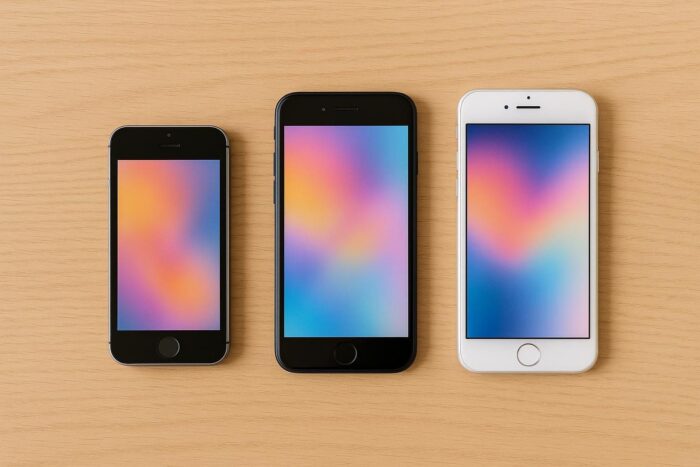
Each generation borrowed its shell from an older iPhone. Here is how they compare on the specs that matter most.
| Model | Released | Chip | Screen | Launch price (US) | Latest iOS |
|---|---|---|---|---|---|
| iPhone SE (1st gen, 2016) | March 31, 2016 | A9 | 4.0-inch LCD | $399 (16GB), $499 (64GB) | iOS 15 |
| iPhone SE (2nd gen, 2020) | April 24, 2020 | A13 Bionic | 4.7-inch LCD | $399 (64GB), $449 (128GB), $549 (256GB) | iOS 27 |
| iPhone SE (3rd gen, 2022) | March 18, 2022 | A15 Bionic | 4.7-inch LCD | $429 (64GB), $479 (128GB), $579 (256GB) | iOS 27 |
iPhone SE (1st generation, 2016)
Apple announced the first model on March 21, 2016, and it reached stores on March 31. It used the body of the iPhone 5s, with a 4-inch 1136 x 640 display, but ran on the A9 chip from the iPhone 6s. It also had a 12-megapixel rear camera that could record 4K video, 2GB of RAM, Touch ID, and a headphone jack. At 113 grams, it remains one of the lightest iPhones Apple has made.
Launch prices were $399 for 16GB and $499 for 64GB. In March 2017 Apple doubled the storage to 32GB and 128GB at the same prices. The phone was discontinued on September 12, 2018. Its last major update was iOS 15, so it can no longer run current apps that require newer versions of iOS.
iPhone SE (2nd generation, 2020)
The second model arrived on April 24, 2020, after an announcement on April 15. It moved to the iPhone 8 design: a 4.7-inch Retina HD display, a glass back with Qi wireless charging, and IP67 water and dust resistance. Inside was the A13 Bionic, the chip from the iPhone 11 series, with 3GB of RAM.
The single 12-megapixel camera supported Portrait mode, Smart HDR, and 4K video at up to 60 frames per second. It added 18W fast charging and eSIM, but dropped the headphone jack. Prices started at $399 for 64GB. Apple replaced it on March 8, 2022. It still receives updates in 2026: it is on Apple’s list of iPhones compatible with iOS 27.
iPhone SE (3rd generation, 2022)
The final iPhone SE was announced on March 8, 2022, and released on March 18. Externally it was almost identical to the 2020 model, same 4.7-inch screen, same dimensions, same Home button. The upgrades were inside: the A15 Bionic from the iPhone 13, 4GB of RAM, 5G support, and a slightly larger 2,018 mAh battery.
Apple also said the front and back glass was the same as on the back of the iPhone 13, and the A15 brought Smart HDR 4, Photographic Styles, and Deep Fusion to the camera. The starting price rose to $429 for 64GB. Colors were midnight, starlight, and (PRODUCT)RED. This model was pulled from Apple’s stores in the European Union at the end of December 2024, because of the USB-C requirement, and discontinued everywhere on February 19, 2025.
Is the iPhone SE still worth buying in 2026?
You can no longer buy a new iPhone SE from Apple, so the question is really about used and refurbished units, or about keeping one you already own. The answer depends heavily on the generation.
- First generation (2016): not recommended as a daily phone. It stopped at iOS 15, so it no longer gets feature updates, and a growing number of apps will not install.
- Second generation (2020): still supported by iOS 27, which is impressive for a phone that launched with iOS 13.4. It works fine for calls, messaging, and light use. Battery life was a common complaint even when new, so check battery health before buying one.
- Third generation (2022): the best choice if you want a small iPhone with Touch ID. The A15 chip is still quick, 5G is included, and it also runs iOS 27.
Keep in mind what none of them can do. No iPhone SE supports Apple Intelligence, none has Night mode, and all three use Lightning rather than USB-C. The camera is a single lens without an ultra-wide option. If those features matter to you, look at a newer model.
How long Apple supported each iPhone SE
Long software support was one of the strongest arguments for buying an iPhone SE, and the record bears it out.
- 2016 model: shipped with iOS 9 and received every major version up to iOS 15. Apple left it out of iOS 16 in 2022, so it got seven major versions in total.
- 2020 model: shipped with iOS 13.4 and is still supported by iOS 27, released in September 2026. That makes fifteen major versions, from iOS 13 to iOS 27.
- 2022 model: shipped with iOS 15.4 and also runs iOS 27, thirteen major versions so far.
Apple kept the same compatibility list for iOS 27 as for iOS 26, so no iPhone lost support this year. Apple does not announce in advance when a model will be dropped, which means nobody can say for sure how long the 2020 and 2022 models will keep receiving new versions. Keep in mind that a supported phone does not always get every new feature: many recent additions, including Apple Intelligence, require newer hardware.
Who the iPhone SE suits today
The iPhone SE still has a clear audience, even as a used purchase:
- People who prefer a small phone. The 4.7-inch models are far easier to use with one hand than any current non-foldable iPhone, all of which have screens of 6.1 inches or more.
- Fans of Touch ID and the Home button. Since February 2025, Apple no longer sells any new iPhone with a Home button. The SE is the most recent way to get one.
- A first phone for a child or a backup device. A low price, iOS updates, and Apple’s parental controls make the 2020 or 2022 model a practical option.
- Anyone who needs an iPhone on a tight budget. A refurbished SE costs less than a new iPhone 17e, and the 2022 model still gets the latest iOS.
It suits power users, mobile photographers, and heavy gamers much less. The small battery and single camera show their age quickly under that kind of use.
iPhone SE vs iPhone 16e: what changed
When Apple announced the iPhone 16e on February 19, 2025, it presented it as a member of the iPhone 16 family, not as a fourth iPhone SE. The differences go well beyond the name.
| Feature | iPhone SE (3rd gen) | iPhone 16e |
|---|---|---|
| Launch price | $429 (64GB) | $599 (128GB) |
| Display | 4.7-inch LCD | 6.1-inch OLED (Super Retina XDR) |
| Chip | A15 Bionic | A18 |
| Unlock | Touch ID (Home button) | Face ID |
| Rear camera | 12MP | 48MP Fusion with 2x telephoto crop |
| Port | Lightning | USB-C |
| Apple Intelligence | No | Yes |
| Modem | Qualcomm | Apple C1 |
The iPhone 16e also brought the Action button and Apple’s first in-house modem, the C1. In exchange, the starting price jumped by $170 compared with the last SE, though base storage doubled to 128GB. For people who wanted the cheapest possible iPhone, that increase was the real change.
What replaced the iPhone SE in 2026: the iPhone 17e
Apple announced the iPhone 17e on March 2, 2026, and released it on March 11. It is now the entry point of the iPhone lineup, which is topped by the iPhone 18 Pro, iPhone 18 Pro Max, and the foldable iPhone Duo announced on September 9, 2026.
The iPhone 17e keeps the 6.1-inch OLED screen and Face ID, and moves to the A19 chip and Apple’s C1X modem. It also adds MagSafe, which the 16e lacked. It launched at $599 with 256GB of storage. On Apple’s US store in September 2026, it starts at $699 for 256GB, after Apple raised prices on several models at its September event.
In practical terms, the modern “budget iPhone” is a full-screen phone with the same basic design as the flagships. It is more capable than any iPhone SE, but also larger and more expensive.
Why Apple ended the iPhone SE line
Apple has not published an official explanation, but several verifiable factors point in the same direction:
- USB-C regulation. The EU requirement for USB-C charging ports took effect on December 28, 2024. The SE’s Lightning port meant Apple had to stop selling it there.
- Apple Intelligence. Apple’s AI features need newer chips and more memory than the SE’s A15 and 4GB of RAM. The 16e was built to support them.
- A dated design. The iPhone 8 body dates back to 2017. By 2025, the Home button was the last one in Apple’s lineup.
- A new naming strategy. By using “16e” and then “17e”, Apple ties its cheapest phone to the current generation instead of positioning it as a separate product.
How to choose between an iPhone SE and a newer model
If your budget allows the iPhone 17e, it is the better phone in almost every way: screen, camera, battery, software support, and Apple Intelligence. It will also receive updates for much longer than any SE.
If you want the smallest possible iPhone, or you simply prefer Touch ID, a refurbished third-generation SE is the one to target. Check battery health in Settings, confirm the model number, and make sure the phone is not locked to someone else’s Apple Account.
If you already own a 2020 or 2022 model that still works well, there is no urgency to replace it while it receives iOS updates. A battery replacement often gives it another year or two of comfortable use.
iPhone SE FAQ
Is Apple still selling the iPhone SE?
No. Apple discontinued the third-generation iPhone SE on February 19, 2025. Only used and refurbished units remain on the market.
Will there be an iPhone SE 4?
Apple has not announced one. The phone expected to be the iPhone SE 4 launched as the iPhone 16e, and its successor is the iPhone 17e.
Which iPhone SE models support iOS 27?
The second-generation (2020) and third-generation (2022) models both appear on Apple’s iOS 27 compatibility list. The 2016 model stopped at iOS 15.
How can I tell which iPhone SE I have?
Go to Settings, then General, then About, and look at the model name. The 2016 model has a 4-inch screen and flat edges; the 2020 and 2022 models look alike, but only the 2022 version supports 5G.