Buying an iPhone 17 unlocked from Apple costs a little more upfront in October 2026, but it leaves you free to switch carriers, travel with a local eSIM and resell the phone easily. Buying through a carrier can lower the price, at the cost of a lock that stays in place until the phone is paid off.
Which route is better depends on how you pay and how long you plan to stay with your carrier. Here is how both options work, what they cost and what to check before you buy.
What “unlocked” means for an iPhone 17
An unlocked iPhone accepts service from any compatible carrier. A locked one only works with the carrier that sold or financed it. According to Apple, iPhones bought directly from Apple are generally unlocked, while iPhones financed through a carrier remain locked to that carrier until they are paid in full.
Apple’s store makes the difference visible: every iPhone 17 configuration can be ordered with activation on one of the major US carriers, or as “Connect on your own later,” which is the unlocked version.
iPhone 17 unlocked price vs carrier activation
In October 2026, Apple lists the standard iPhone 17 at the following prices:
| Storage | With carrier activation at Apple | Unlocked (connect later) |
|---|---|---|
| 256GB | $899 | $929 |
| 512GB | $1,099 | $1,129 |
The $30 gap is a connectivity discount that Apple applies only when the phone is activated with a carrier at purchase. It does not apply to prepaid plans or to phones you connect later. The iPhone 17e, by contrast, shows the same price either way: $699 for 256GB and $899 for 512GB.
Carrier stores and websites run their own promotions, often tied to a trade-in, a new line or a monthly installment plan spread over several years. Those deals can bring the effective price down sharply, but they usually come with conditions: staying on a specific plan, receiving credits month by month, and keeping the phone locked until the balance is cleared.
Unlocked or carrier: pros and cons
Buying unlocked
- Freedom: switch carriers or plans whenever a better offer appears.
- Travel: add a local or travel eSIM abroad instead of paying roaming fees.
- Resale value: unlocked phones are easier to sell or hand down.
- Downside: you pay the full price, or use Apple’s own financing options, and miss carrier-specific promotions.
Buying through a carrier
- Lower upfront cost: promotions and trade-in credits can be generous.
- One bill: the phone is folded into your monthly plan.
- Downside: the phone stays locked until it is paid off, credits are often spread over the full term, and leaving early can mean paying the remaining balance.
A simple rule: if you are happy with your carrier and would stay for the length of the deal anyway, a carrier promotion is often the cheapest path. If you value flexibility, travel often or change plans regularly, unlocked is worth the small premium.
eSIM only: what it means for US buyers
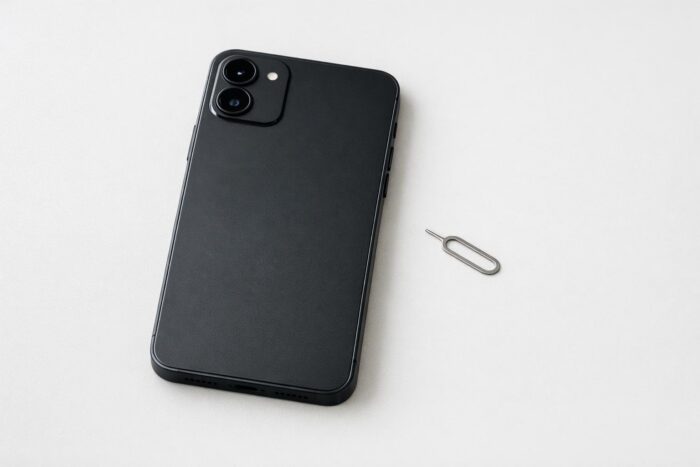
US models of the iPhone 17 family have no SIM tray. Apple’s specs list dual eSIM, with two active lines and room for eight or more stored eSIMs, and state that the phone is not compatible with physical SIM cards. The same applies to the iPhone 17e.
In practice, check that your carrier, including any prepaid or smaller provider, supports eSIM activation before buying. Most transfers happen in a few taps during setup, either from your old iPhone or with a QR code or app from the carrier. If you rely on a provider that only issues physical SIM cards, an unlocked US iPhone 17 will not work with it.
Buying an iPhone 17 Pro or Pro Max unlocked
Apple discontinued the iPhone 17 Pro and 17 Pro Max on September 9, 2026, when it introduced the iPhone 18 Pro models. You can no longer order them new from Apple. If you want one, your options are remaining retail or carrier stock, refurbished units and the used market. That makes the unlock check below essential, because a second-hand Pro Max may still be tied to its original carrier.
If you are open to a cheaper phone instead, our complete look at Apple’s entry-level model explains what you keep and what you give up for $699.
Checklist before you buy
- Lock status: on the phone, go to Settings, General, About, and look at “Carrier Lock.” “No SIM restrictions” means it is unlocked.
- eSIM support: confirm your carrier activates eSIM on iPhone.
- Region: models sold in other countries can differ, including SIM options and supported bands.
- Activation Lock: on a used phone, make sure the seller has removed it from their Apple Account and turned off Find My.
- Financing terms: with a carrier deal, read how long credits last and what happens if you leave early.
FAQ
Is the iPhone 17 from Apple unlocked?
Generally yes, if you pay for it outright or choose “Connect on your own later.” A phone financed through a carrier stays locked to that carrier until it is paid off.
Why is the unlocked iPhone 17 $30 more?
Apple’s $899 price includes a $30 connectivity discount that requires activation with a carrier at purchase. Unlocked, the 256GB model costs $929.
Can I use a physical SIM in a US iPhone 17?
No. US models are eSIM only and do not accept physical SIM cards.
Can I still buy an iPhone 17 Pro Max new?
Not from Apple, which discontinued it in September 2026. Remaining stock elsewhere, refurbished and used units are the remaining options.