The iPhone 16e is the phone that ended the iPhone SE line. Apple announced it on February 19, 2025, started selling it on February 28, 2025, and dropped the iPhone SE (3rd generation) from its store the same day it was unveiled. Gone were the Home button, Touch ID and the 4.7-inch LCD. In came a 6.1-inch OLED screen, Face ID, USB-C and a 48MP camera.
There is a twist in September 2026: the iPhone 16e is no longer Apple’s newest budget model either. The iPhone 17e took its place on March 2, 2026. So the real question for an SE owner today is less “should I buy the 16e?” and more “which ‘e’ model makes sense, and at what price?”
Where the iPhone 16e fits in Apple’s lineup today
Apple’s cheapest iPhone used to be the SE, a phone built from an older body with a newer chip inside. The iPhone 16e changed that formula. It borrowed the notched design of the iPhone 14 generation but ran the A18 chip from the iPhone 16, which let Apple ship Apple Intelligence on its entry model.
Here is how the current lineup looks after the September 9, 2026 event, using Apple’s US starting prices:
- iPhone 17e: $699 (launched at $599 in March 2026, raised by $100 on September 9, 2026)
- iPhone 16: $799
- iPhone 17: $899
- iPhone Air: $1,099
- iPhone 18 Pro and iPhone 18 Pro Max: $1,199 and $1,299
- iPhone Duo, Apple’s first foldable: $1,999, with pre-orders opening October 16, 2026
The iPhone 16e is absent from that list. Apple discontinued it when the 17e arrived, so buying one now means looking at leftover carrier stock, refurbished units or the used market.
iPhone 16e vs iPhone SE: what actually changed
For anyone holding an older iPhone SE, the jump to the 16e is the biggest design change the budget line has ever seen. The table below compares the last SE with its successor.
| Spec | iPhone SE (3rd gen, 2022) | iPhone 16e (2025) |
|---|---|---|
| Launch price (US) | $429 (64GB) | $599 (128GB) |
| Announced | March 8, 2022 | February 19, 2025 |
| Display | 4.7-inch LCD | 6.1-inch Super Retina XDR OLED |
| Chip | A15 Bionic | A18 (4-core GPU), 8GB RAM |
| Rear camera | 12MP wide | 48MP Fusion, 2x optical-quality zoom |
| Front camera | 7MP | 12MP TrueDepth |
| Biometrics | Touch ID (Home button) | Face ID |
| Port | Lightning | USB-C |
| Modem | Qualcomm 5G | Apple C1 (no mmWave) |
| Storage options | 64, 128, 256GB | 128, 256, 512GB |
| Apple Intelligence | No | Yes |
The screen and the size
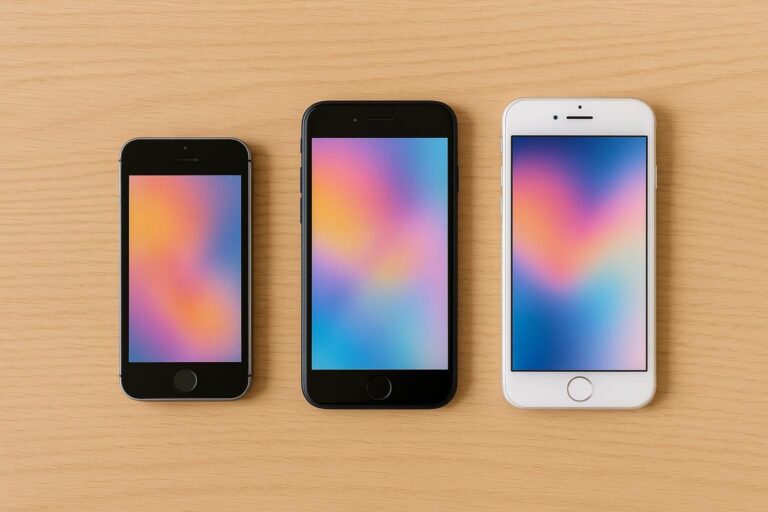
The SE was the last iPhone with a 4.7-inch screen and thick bezels. The 16e uses a 6.1-inch OLED panel with a notch at the top, the same footprint as an iPhone 13 or 14. That means deeper blacks, better HDR and far more room for text and video. It also means a bigger, heavier phone. People who kept the SE precisely because it fit in one hand should hold a 16e before buying.
Face ID instead of the Home button
Touch ID worked well with masks and gloves off; Face ID works without touching anything. The 16e also gained the Action button that replaced the old ring/silent switch, which can launch the camera, a shortcut or a flashlight.
Camera
The 16e has a single 48MP rear camera. Apple uses the high-resolution sensor to offer a 2x crop that behaves like a telephoto lens, something the 12MP SE could not do cleanly. There is still no ultra wide lens, so wide landscapes and macro shots stay out of reach, as they were on the SE.
Chip, AI and battery
The A18 is two generations ahead of the SE’s A15, with 8GB of RAM, which is what Apple Intelligence requires. The iPhone SE (3rd generation) cannot run those features at all. Apple rated the 16e at up to 26 hours of video playback, and reviewers widely praised its battery life, helped by the efficient C1 modem that Apple designed in-house.
What the iPhone 16e left out
The 16e was cheaper than the iPhone 16 for a reason. Compared with its bigger sibling, it skipped:
- MagSafe: it charges wirelessly with standard Qi pads, but magnetic chargers and wallets do not snap on. It is the last iPhone without MagSafe.
- Dynamic Island: it keeps a classic notch.
- Ultra wide camera and Camera Control button.
- Ultra Wideband, used for precise AirTag finding.
- mmWave 5G, which matters only in a few dense US areas.
Critics at launch mostly agreed on the trade-off: an excellent battery and a modern chip, but a $599 price that sat $170 above where the SE had started, without MagSafe.
iPhone 16e vs iPhone 17e: the newer “e” model
The iPhone 17e, announced March 2, 2026, keeps the same 6.1-inch notched body and fixes the two most common complaints about the 16e.
| Spec | iPhone 16e | iPhone 17e |
|---|---|---|
| Launch price (US) | $599 (128GB) | $599 (256GB), $699 since Sept 9, 2026 |
| Chip | A18 | A19 |
| Modem | C1 | C1X |
| MagSafe / Qi2 | No | Yes, up to 25W |
| Base storage | 128GB | 256GB |
| Colors | Black, White | Black, White, Soft Pink |
If you can find a new or like-new iPhone 16e well below the 17e’s current $699 price, it remains a capable phone. At similar money, the 17e is the easier pick thanks to MagSafe, the newer chip and double the base storage.
Should you upgrade from an iPhone SE to the iPhone 16e?
It depends on which SE you own and why you kept it.
iPhone SE (1st generation, 2016)
This one stopped at iOS 15 and no longer receives feature updates. Any modern iPhone is a large upgrade in security, app compatibility and camera quality. The 16e or 17e is a sensible landing spot if you accept the larger size.
iPhone SE (2nd generation, 2020)
Apple still lists it as compatible with iOS 27, but its A13 chip and small battery show their age, and it gets none of the Apple Intelligence features. Moving to a 16e brings a much bigger screen, a better camera and noticeably longer battery life.
iPhone SE (3rd generation, 2022)
Also on Apple’s iOS 27 compatibility list, with 5G and a fast A15. If the phone still holds a charge and you love the Home button, there is no urgency. Upgrade if battery life has faded, if you want Apple Intelligence, or if the 64GB base model keeps running out of space.
When to stay put
If one-handed use is the reason you bought an SE, no current iPhone matches it. The 16e and 17e are both 6.1-inch phones. In that case, a new battery for your SE may buy another year or two before you have to choose.
Who the iPhone 16e suits best
The 16e makes the most sense for buyers who want a modern iPhone for messaging, photos, maps and banking apps, and who care more about battery life than about camera extras. It is a good first iPhone for a teenager, a solid work phone and a reasonable replacement for a parent still using a Home-button model.
It is a weaker choice if you already own MagSafe accessories, shoot a lot of wide-angle or macro photos, or rely on AirTag precision finding. In those cases the iPhone 16, at $799 new from Apple in September 2026, or the MagSafe-equipped 17e will serve you better.
iPhone 16e price: then and now
At launch, Apple charged $599 for 128GB, $699 for 256GB and $899 for 512GB. Since Apple no longer sells the phone, there is no official current price. Resale and refurbished prices vary by condition and storage, so compare them against the 17e’s $699 starting price with 256GB before deciding.
iPhone 16e FAQ
Is the iPhone 16e the new iPhone SE?
Yes, in practice. It replaced the iPhone SE (3rd generation) in February 2025, and Apple has not released an SE model since. The iPhone 17e now holds that entry-level spot.
Does the iPhone 16e have MagSafe?
No. It supports standard Qi wireless charging only. MagSafe arrived on the “e” line with the iPhone 17e.
Is the iPhone 16e still sold by Apple?
No. Apple discontinued it on March 2, 2026, when the iPhone 17e was announced. You can still find it through refurbished and used channels.
Does the iPhone 16e support Apple Intelligence?
Yes. Its A18 chip and 8GB of RAM meet Apple’s requirements, which none of the iPhone SE models do.