iPhone Air vs iPhone 17 comes down to one trade: the Air is bigger, thinner and lighter, while the iPhone 17 has a second rear camera, longer rated battery life and a lower price. Both belong to the iPhone 17 generation launched in September 2025, and both are still sold by Apple in October 2026.
If you want the most capable phone for the money, the iPhone 17 is the safer pick. If the design and a 6.5-inch screen in a 5.64 mm body are what excite you, the Air is the only phone that offers that.
iPhone Air vs iPhone 17: specs side by side
| iPhone Air | iPhone 17 | |
|---|---|---|
| Price (Apple US, October 2026) | From $1,099 | From $899 with carrier activation, $929 unlocked |
| Screen | 6.5-inch OLED, 120Hz ProMotion | 6.3-inch OLED, 120Hz ProMotion |
| Dimensions | 156.2 x 74.7 x 5.64 mm | 149.6 x 71.5 x 7.95 mm |
| Weight | 165 g | 177 g |
| Chip | A19 Pro, 5-core GPU | A19, 5-core GPU |
| Rear cameras | 48MP Fusion main | 48MP Fusion main, 48MP Fusion ultra wide |
| Front camera | 18MP Center Stage | 18MP Center Stage |
| Video playback | Up to 27 hours | Up to 30 hours |
| Streamed video | Up to 22 hours | Up to 27 hours |
| Wireless charging | MagSafe and Qi2 up to 20W | MagSafe and Qi2 up to 25W |
| Storage | 256GB, 512GB, 1TB | 256GB, 512GB |
| Colors | Space Black, Cloud White, Light Gold, Sky Blue | Black, White, Mist Blue, Sage, Lavender |
Both phones share the Dynamic Island, an Always-On display, Camera Control, the Action button, Apple’s N1 chip with Wi-Fi 7 and Bluetooth 6, eSIM only and IP68 water resistance. Data from Apple’s technical specifications.
Design: the Air’s whole point
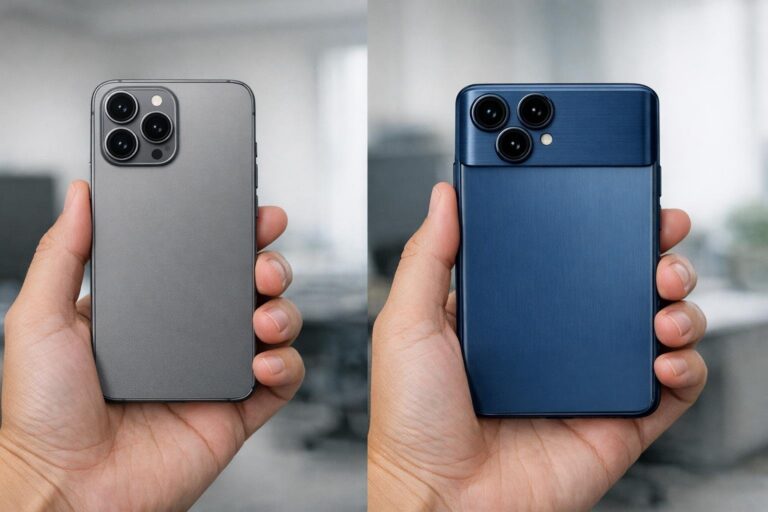
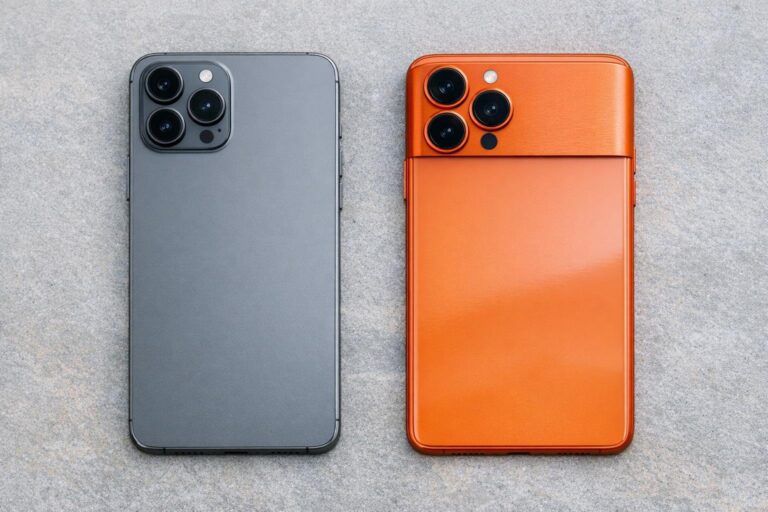
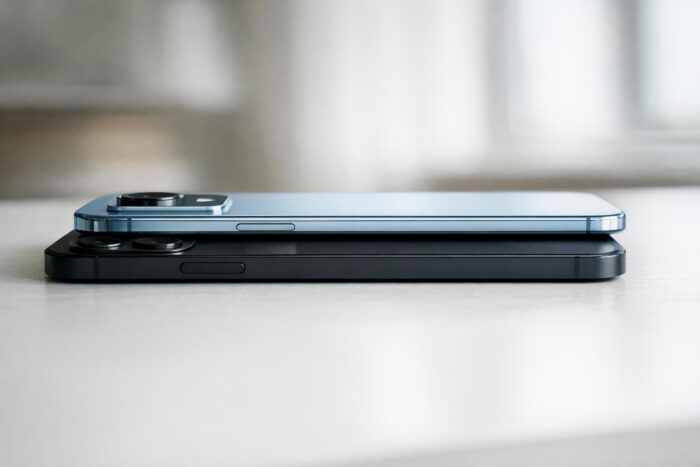
The Air is 5.64 mm thick, about 2.3 mm thinner than the iPhone 17, and it is 12 g lighter despite a larger screen. Its frame is titanium. The difference is obvious in a pocket or a jacket, and it is the reason the phone exists. Apple built the iPhone 17 Air, as many buyers call it, around this goal, placing the cameras, speaker and chips in a raised plateau across the top of the back.
The iPhone 17 is a more conventional slab, but at 6.3 inches and 177 g it is still easy to handle. If one-handed use matters, its narrower 71.5 mm body is an advantage over the Air’s 74.7 mm.
Screen
Both displays are OLED panels at 460 ppi with ProMotion up to 120Hz, 1600 nits peak HDR and 3000 nits peak outdoors. The only real difference is size: 6.5 inches on the Air, 6.3 inches on the iPhone 17. For video and reading, the Air’s extra space is welcome.
Cameras: the iPhone 17 is more versatile
Both phones use a 48MP Fusion main camera and can deliver 2x shots Apple rates as optical quality. The iPhone 17 adds a 48MP Fusion ultra wide (13 mm, 120-degree field of view), which unlocks wide shots of rooms and landscapes, macro photography and spatial photos. The Air has none of that.
The front cameras are identical: the 18MP Center Stage camera, which can widen the frame for group selfies and records 4K video. If you mostly take selfies and photos with the main lens, the gap shrinks. If you like to vary your framing, it is the decisive argument for the iPhone 17.
Battery and charging
Thinness costs battery. Apple rates the iPhone 17 at up to 30 hours of video playback and 27 hours streamed, against 27 and 22 hours for the Air, a five-hour gap on streaming. The iPhone 17 also charges faster: 50% in about 20 minutes with a 40W adapter, and up to 25W wirelessly, compared with 50% in 30 minutes with a 20W adapter and up to 20W wireless for the Air.
Apple offers an iPhone Air MagSafe Battery, launched at $99, which extends the Air to 40 hours of video playback. It works, but it adds thickness and cost.
Performance
The Air has the A19 Pro, the iPhone 17 the A19. Both have 6-core CPUs and 5-core GPUs in these configurations. For everyday use, apps and Apple Intelligence, you will not tell them apart. At least one published review judged the Air’s gaming performance insufficient, so do not choose it for the “Pro” in its chip name alone.
Price
In October 2026, Apple’s US store lists the iPhone 17 at $929 unlocked for 256GB ($899 with carrier activation) and $1,129 for 512GB. The Air costs $1,099 for 256GB, $1,299 for 512GB and $1,699 for 1TB. Both prices include the $100 increase Apple applied on September 9, 2026. The Air is the only one of the two available with 1TB.
If neither price fits, the cheaper option in the same generation is the iPhone 17e at $699: our complete guide to Apple’s budget model explains what it keeps from these two phones and what it drops.
Which one should you buy?
- Choose the iPhone 17 if you want the best battery life, an ultra wide camera, faster charging and the lower price.
- Choose the iPhone Air if a large screen in a very thin and light phone matters more to you than a second camera and a few hours of battery.
FAQ
Is the iPhone Air better than the iPhone 17?
Not overall. It is thinner, lighter, has a bigger screen and the A19 Pro chip, but the iPhone 17 has more cameras, longer battery life and costs less.
Which has better battery life, the iPhone Air or the iPhone 17?
The iPhone 17: up to 30 hours of video playback against 27 hours for the Air, according to Apple.
Do the iPhone Air and iPhone 17 have the same front camera?
Yes, both use the 18MP Center Stage front camera.