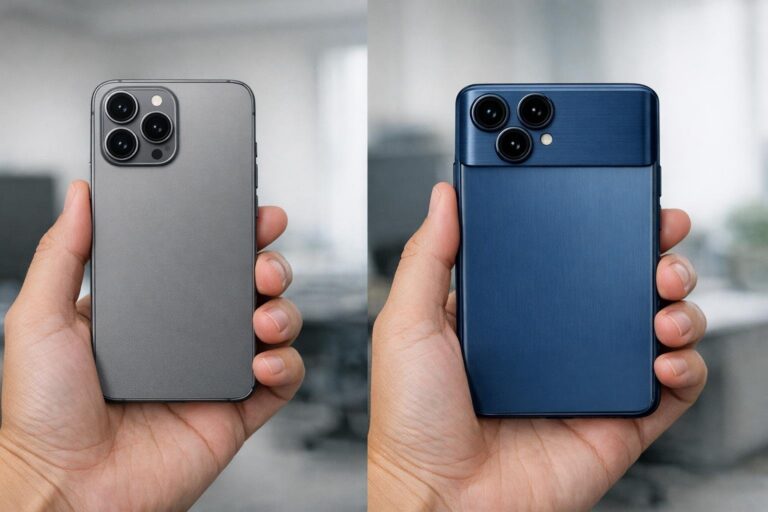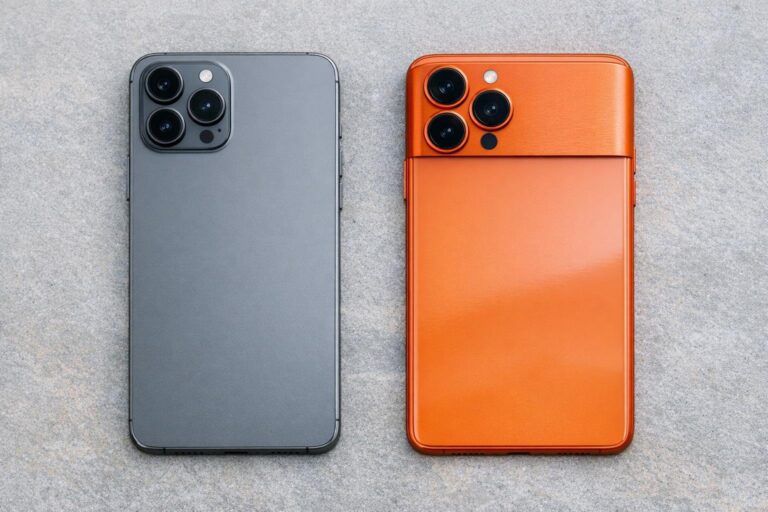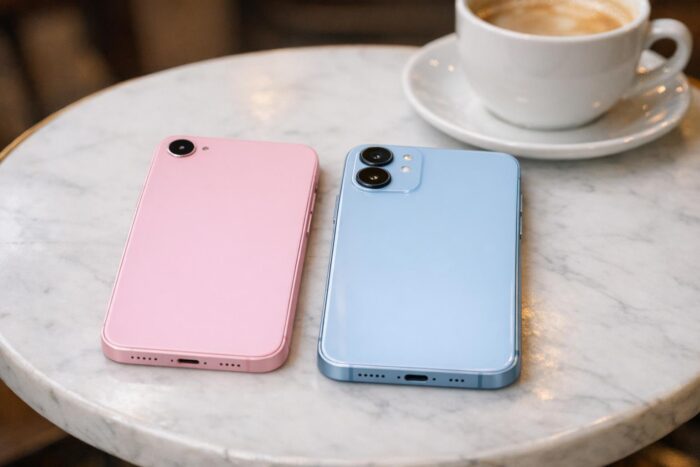
In the iPhone 17e vs 17 matchup, the iPhone 17 wins on almost every hardware point: a 120Hz ProMotion display, a second 48MP camera for ultra wide shots, a better selfie camera and longer rated battery life. The iPhone 17e wins on price, at $699 against $899 in October 2026.
Both phones run on Apple’s A19 chip, both start with 256GB and both support MagSafe. So the question is simple: are the screen and camera upgrades worth $200 to you? Below, we go through each difference and give a clear recommendation.
iPhone 17e vs 17: specs side by side
| Feature | iPhone 17e | iPhone 17 |
|---|---|---|
| Released | March 11, 2026 | September 19, 2025 |
| Price (Oct. 2026, 256GB) | $699 | $899 with carrier activation, $929 unlocked |
| Display | 6.1-inch OLED, 60Hz | 6.3-inch OLED, ProMotion up to 120Hz, Always-On |
| Brightness | 800 nits typical, 1200 nits HDR peak | 1000 nits typical, 1600 nits HDR peak, 3000 nits outdoor |
| Chip | A19, 6-core CPU, 4-core GPU | A19, 6-core CPU, 5-core GPU |
| Rear cameras | 48MP Fusion main (2x crop) | 48MP Fusion main (2x crop), 48MP Fusion ultra wide |
| Front camera | 12MP | 18MP Center Stage |
| Dynamic Island / Camera Control | No / No | Yes / Yes |
| Video playback (rated) | Up to 26 hours | Up to 30 hours |
| Wireless charging | MagSafe and Qi2 up to 15W | MagSafe and Qi2 up to 25W |
| Size and weight | 146.7 x 71.5 x 7.80 mm, 169 g | 149.6 x 71.5 x 7.95 mm, 177 g |
| Storage | 256GB, 512GB | 256GB, 512GB |
| Colors | Black, white, soft pink | Black, white, mist blue, sage, lavender |
All specs come from Apple’s technical specifications pages.
Display: the biggest everyday difference
The screen is where the iPhone 17 earns most of its premium. ProMotion lets it refresh at up to 120Hz, so scrolling, swiping and animations look noticeably smoother. The 17e stays at 60Hz, like the iPhone 16e before it. People who have never used a 120Hz phone may not miss it; people coming from one usually do.
The iPhone 17 also has an Always-On display, which shows the time, widgets and notifications on a dimmed lock screen, and it is brighter: up to 3000 nits outdoors compared with 1200 nits peak (HDR) on the 17e. That matters in direct sunlight. The 17e’s screen is also smaller, at 6.1 inches against 6.3, and it does without the Dynamic Island, the pill-shaped area at the top of the iPhone 17’s display that shows live activities and alerts.
Cameras: one lens or two
Both phones use a 48MP Fusion main camera that can crop to a 2x telephoto view, so everyday photos from the main lens are in the same league. The difference is what else you get.
- Ultra wide: the iPhone 17 adds a 48MP ultra wide camera for landscapes, interiors, architecture and group shots. The 17e has no ultra wide at all.
- Selfies: the iPhone 17’s 18MP Center Stage front camera can widen the frame for group selfies and video calls. The 17e has a 12MP front camera.
- Camera Control: the iPhone 17 has the dedicated button on the side for launching the camera and adjusting settings. The 17e does not.
If you often shoot wide scenes or take group selfies, this is the strongest argument for the iPhone 17.
Performance and chip
Both phones use the A19 chip with a 6-core CPU, so apps, browsing and everyday tasks run at the same level. The iPhone 17’s version has a 5-core GPU against 4 on the 17e, which gives it an edge in demanding games and graphics work. For most uses, you will not feel a difference. Both support Apple Intelligence.
Battery and charging
Apple rates the iPhone 17 for up to 30 hours of video playback and the 17e for up to 26 hours. Those are Apple’s lab figures, not real-world measurements, but they point the same way: the iPhone 17 should last longer between charges.
Charging follows the same pattern. Both support MagSafe, a first for the “e” line, but the 17e tops out at 15W wirelessly while the iPhone 17 reaches 25W. With a 40W USB-C adapter, Apple says the iPhone 17 charges to 50% in 20 minutes; the 17e reaches 50% in 30 minutes with a 20W adapter or higher.
Design and durability: closer than you think
On build quality, the two phones are close. Both have a Ceramic Shield 2 front cover that Apple says is three times more scratch resistant than the previous generation, and an IP68 rating for water and dust (up to 6 meters for 30 minutes). Both have the Action button, and both use a USB-C port limited to USB 2 speeds, so neither is built for fast wired file transfers.
The iPhone 17 is a little larger in hand: 149.6mm tall against 146.7mm, with the same 71.5mm width. It is also 8 grams heavier. If you liked the compact feel of a 6.1-inch iPhone, the 17e keeps it, while the iPhone 17 gives you a slightly larger canvas for video and reading without becoming a big phone.
Connectivity
The 17e uses Apple’s own C1X cellular modem, which Apple says is up to twice as fast as the C1 in the iPhone 16e. The iPhone 17 uses Apple’s N1 wireless chip for Wi-Fi 7 and Bluetooth 6, and supports 5G. In daily use, both handle 5G networks, calls and hotspots without trouble; the iPhone 17 simply has the newer Wi-Fi standard if your home router supports it.
Price: is the iPhone 17 worth $200 more?
In October 2026, the iPhone 17e costs $699 for 256GB and $899 for 512GB. The iPhone 17 costs $899 for 256GB with carrier activation, or $929 unlocked, and $1,129 unlocked for 512GB. Both prices rose by $100 on September 9, 2026, so the gap between them is the same as at launch.
Spread over three years of ownership, the extra $200 to $230 works out to roughly $6 a month for a smoother, brighter screen, an extra camera and longer battery life. For many buyers that is a good trade. For others, the 17e already does everything they need.
Which should you buy?
Buy the iPhone 17e if…
- you want the cheapest new iPhone with current hardware and 256GB;
- you mostly message, call, browse and take photos with the main camera;
- you prefer a slightly smaller, lighter phone;
- you want a pink iPhone, which only the 17e offers in the iPhone 17 family.
To see how it fits against the rest of the range, read our full guide to the entry-level iPhone 17e, which covers it beyond this head-to-head.
Buy the iPhone 17 if…
- you scroll a lot and want a 120Hz display;
- you use the ultra wide camera or take group selfies;
- you want the longest battery life and faster charging;
- you plan to keep the phone four years or more and want the extra headroom.
Our verdict: for most people, the iPhone 17 is the better phone and worth the stretch. The iPhone 17e is the smart pick when budget comes first or when the phone is for someone with simple needs.
iPhone 17e vs 17 FAQ
Is the iPhone 17e the same as the iPhone 17?
No. It shares the A19 chip family and 256GB base storage, but it has a 60Hz 6.1-inch screen, a single rear camera, no Dynamic Island and lower rated battery life.
Does the iPhone 17e have 120Hz?
No. ProMotion at up to 120Hz is reserved for the iPhone 17 and the more expensive models.
Which is bigger, the iPhone 17e or the iPhone 17?
The iPhone 17 is slightly bigger, with a 6.3-inch screen against 6.1 inches, and it weighs 177 grams against 169.
Do both support MagSafe?
Yes. The 17e charges at up to 15W with MagSafe and the iPhone 17 at up to 25W.