The iPhone 17 Pro launched on September 19, 2025 at $1,099 for 256GB, while the iPhone 17e arrived in March 2026 at $599 for the same storage. That gap of $500 buys a lot of hardware: three 48MP cameras including a 4x telephoto, a 120Hz ProMotion display that gets far brighter outdoors, the A19 Pro chip with a vapor chamber, faster charging and a USB 3 port.
The question is whether you will actually use those extras. For most people who text, browse, stream and take photos of family and food, the 17e covers the essentials. The Pro earns its price for people who zoom, film, edit, or play demanding games for long sessions.
One piece of timing matters: Apple introduced the iPhone 18 Pro on September 9, 2026 and stopped selling the iPhone 17 Pro in its own store. In October 2026, Apple’s comparison page lists the 17 Pro as available at authorized resellers only. This guide compares the two phones on hardware and tells you who should still consider the 17 Pro.
iPhone 17 Pro and iPhone 17e at a glance
The table below uses Apple’s US tech specs for both phones. Battery figures are Apple’s rated video playback numbers, not our measurements.
| Spec | iPhone 17 Pro | iPhone 17e |
|---|---|---|
| Launch price (256GB) | $1,099 (September 2025) | $599 (March 2026) |
| Storage | 256GB, 512GB, 1TB | 256GB, 512GB |
| Display | 6.3-inch OLED, ProMotion up to 120Hz | 6.1-inch OLED, no ProMotion |
| Peak brightness | 3000 nits outdoor, 1600 nits HDR | 1200 nits HDR |
| Chip | A19 Pro, 6-core GPU, vapor chamber | A19, 4-core GPU |
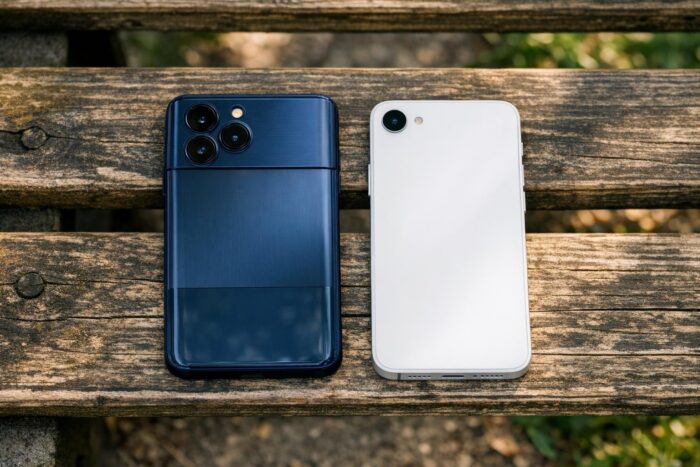
| Rear cameras | 48MP main, 48MP ultra wide, 48MP 4x telephoto | 48MP main only |
| Front camera | 18MP Center Stage | 12MP TrueDepth |
| Video playback | Up to 33 hours | Up to 26 hours |
| MagSafe / Qi2 | Up to 25W | Up to 15W |
| USB-C | USB 3, up to 10Gb/s | USB 2, up to 480Mb/s |
| Weight | 206 g (7.27 oz) | 169 g |
The telephoto camera is the biggest difference
The iPhone 17e has one rear camera: a 48MP Fusion main lens at 26 mm, with a 12MP 2x crop that Apple calls optical quality. That is a good camera for everyday shots in daylight, but it stops there. No ultra wide for tight rooms or landscapes, and no real zoom.
The iPhone 17 Pro carries three 48MP sensors:
- Fusion Main: 24 mm, f/1.78, with second-generation sensor-shift stabilization and a 2x crop at 48 mm.
- Fusion Ultra Wide: 13 mm, f/2.2, with a 120-degree field of view and macro shots.
- Fusion Telephoto: 100 mm (4x), f/2.8, using a tetraprism design, plus an 8x crop at 200 mm.
Apple rates the system at 8x optical-quality zoom in and 2x out, a 16x range in total, with digital zoom up to 40x. In practice, this is what lets you photograph a child on a stage, a bird in a tree or a building detail without walking closer. If you regularly pinch to zoom on a phone with one camera and get mushy results, the telephoto alone may justify the Pro.
Video follows the same pattern. The 17 Pro records 4K Dolby Vision up to 120 fps, ProRes RAW, Apple Log 2 and supports Genlock with compatible hardware, features aimed at people who edit footage or shoot with multiple cameras. The front camera also moved to an 18MP Center Stage sensor that keeps a group in frame, while the 17e keeps a 12MP TrueDepth camera.
ProMotion display and outdoor brightness
The 17 Pro’s 6.3-inch screen refreshes at up to 120Hz, so scrolling and animations look smoother, and it drops low when the screen is static to save power, which is what makes the Always-On display possible. Apple rates it at 3000 nits peak brightness outdoors and 1 nit minimum for reading in the dark.
The 17e’s 6.1-inch panel is a sharp OLED at 460 ppi, the same pixel density as the Pro, but Apple’s spec sheet lists no ProMotion and a typical maximum of 800 nits, 1200 nits for HDR content. It is perfectly usable, just less smooth and harder to read in direct summer sun.
It is worth knowing that the regular iPhone 17 also has a 120Hz ProMotion screen. If smoothness is your main complaint about the 17e, you do not need to jump all the way to the Pro.
Design, build and the aluminum unibody
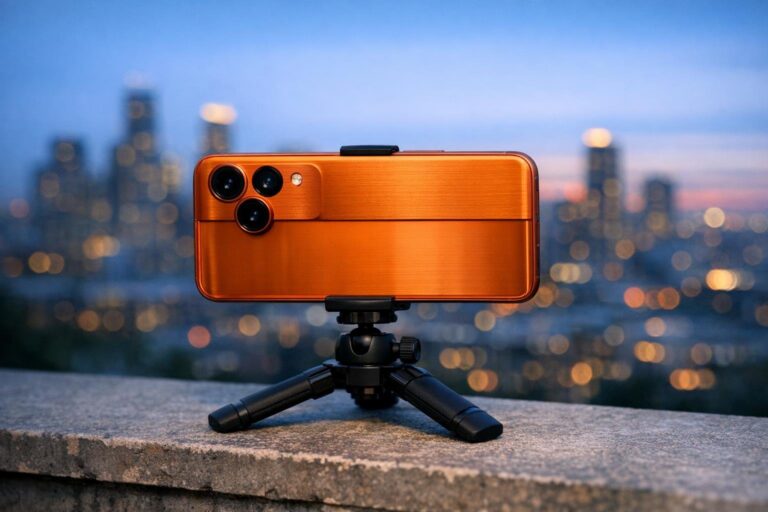
Apple moved the 17 Pro from titanium to a brushed aluminum unibody, with a raised camera plateau that runs across the top of the back. That plateau frees space for a larger battery, and a vapor chamber laser-welded into the chassis moves heat away from the A19 Pro. The benefit shows up in long gaming sessions or 4K recording, when a phone would otherwise slow down to stay cool, rather than in quick tasks.
The front uses Ceramic Shield 2, and Ceramic Shield protects the back as well. The phone is rated IP68, up to 6 meters for 30 minutes. It comes in three finishes: silver, cosmic orange and deep blue.
The trade-off is weight. At 206 g, the 17 Pro is 37 g heavier than the 17e, a difference you notice in a pocket and when reading in bed. The 17e is also thinner at 7.80 mm against 8.75 mm.
Performance, battery and charging
Both phones use a member of the A19 family with a 6-core CPU and a 16-core Neural Engine, so daily apps and Apple Intelligence features run well on either. The gap is graphics: 6 GPU cores with Neural Accelerators on the Pro against 4 on the 17e, plus the Pro’s cooling for sustained loads.
Apple rates the 17 Pro at up to 33 hours of video playback in the US, against 26 hours for the 17e. Charging is faster too: 50 percent in about 20 minutes with a 40W adapter, against 30 minutes with a 20W adapter on the 17e, and 25W MagSafe against 15W.
The USB-C port is another quiet difference. The Pro transfers at up to 10Gb/s over USB 3, useful if you offload ProRes video to a drive. The 17e uses USB 2 speeds, fine for charging and occasional transfers.
Connectivity favors the Pro as well, with Apple’s N1 chip for Wi-Fi 7 and Bluetooth 6, while the 17e has Wi-Fi 6 and Bluetooth 5.3. The Pro also has Camera Control, the capture button on the side that the 17e lacks. Both have the Action button. If you want a deeper look at the cheaper phone, including its battery and storage options, read our complete iPhone 17e guide.
Is the iPhone 17 Pro worth nearly twice the price?
At launch, the Pro cost about 1.8 times as much as the 17e. Today the comparison is less direct: since Apple’s September 9, 2026 price increase, the 17e sells for $699 (256GB) on Apple’s US store in October 2026, while the 17 Pro is now sold only through other channels at prices that vary by seller.
Here is a simple way to decide:
- Choose the iPhone 17e if you shoot mostly at arm’s length, care about weight, and want the lowest price for a current Apple phone with long software support.
- Choose the iPhone 17 Pro if you zoom often, film video you plan to edit, play games for long stretches, or use the phone outdoors a lot.
- Look at the iPhone 17 if you mainly want the 120Hz screen, a second camera and Camera Control, without paying for a telephoto.
- Look at the iPhone 18 Pro if you want the newest Pro with the longest support window; Apple lists it from $1,199 for 256GB.
The 17 Pro is not a bad buy in late 2026, but it only makes sense at a clear discount to the 18 Pro, from a seller you trust, with Apple’s warranty status checked.
FAQ
When did the iPhone 17 Pro come out?
Apple announced it on September 9, 2025, opened preorders on September 12 and released it on September 19, 2025 in the US.
Does Apple still sell the iPhone 17 Pro?
No. After the iPhone 18 Pro announcement in September 2026, Apple’s comparison page lists the 17 Pro as available at authorized resellers rather than in the Apple Store.
Does the iPhone 17e have a telephoto camera?
No. It has a single 48MP main camera with a 2x crop. The 17 Pro adds a 48MP 4x telephoto that reaches 8x optical-quality zoom.
Is the iPhone 17 Pro waterproof?
It is water resistant, not waterproof. Apple rates it IP68, up to 6 meters for 30 minutes, the same rating as the 17e.