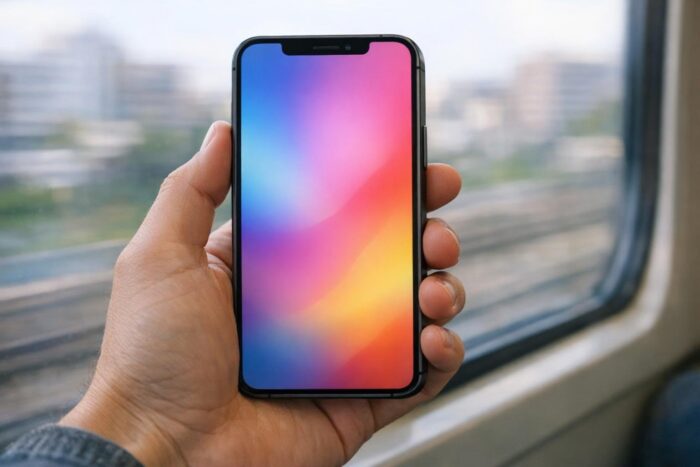
Our iPhone 17e review verdict in one line: it is the best value in Apple’s lineup for people who want a current chip, long battery life and 256GB of storage, as long as they can accept a single camera and a 60Hz screen with a notch. It is not the phone for photography enthusiasts or anyone already used to a 120Hz display.
This review is a synthesis. It is built on Apple’s specifications, the changes from the iPhone 16e and what published reviews have praised and criticized since the phone went on sale on March 11, 2026. We do not report battery or benchmark numbers of our own.
iPhone 17e review: the short verdict
| Strengths | Weaknesses |
|---|---|
| A19 chip from the current generation | Single rear camera, no ultra wide |
| Strong rated battery life (26 hours video) | 60Hz screen, notch instead of Dynamic Island |
| 256GB base storage | Wi-Fi 6 only, USB 2 port |
| MagSafe and Qi2 charging at 15W | Price raised to $699 in September 2026 |
| IP68, Ceramic Shield 2, Action button | No Camera Control, 12MP selfie camera |
What the iPhone 17e is
Apple announced the 17e on March 2, 2026 as the successor to the iPhone 16e. It launched at $599 for 256GB, and since Apple’s price increase of September 9, 2026, it costs $699 for 256GB and $899 for 512GB on Apple’s US store (October 2026). It remains the cheapest new iPhone Apple sells.
The phone keeps the size and screen of the 16e: a 6.1-inch OLED, 146.7 x 71.5 x 7.80 mm, 169 g, in Black, White or Soft Pink. The upgrades are under the glass: the A19 chip, the C1X modem, MagSafe and a stronger front cover. For the full spec sheet, prices and comparisons across the range, our guide to the 17e goes through each point in detail.
Performance: the strongest argument
The A19 is a 3nm chip with a 6-core CPU, a 4-core GPU with Neural Accelerators and a 16-core Neural Engine. It is the same chip family as the iPhone 17, with one GPU core fewer. In practice, that means the 17e runs current apps, Apple Intelligence features and iOS 27 on this year’s silicon rather than on a chip from a previous generation, a good sign for a phone many buyers will keep for five years or more.
The Guardian’s review counted performance among the phone’s main strengths. The one area where the trimmed GPU can show is long sessions of demanding 3D games, where the iPhone 17 and Air have more headroom.
Battery and charging
Apple rates the 17e for up to 26 hours of video playback and 21 hours of streamed video, the same video rating as the 16e, from a battery listed at 4,005 mAh. The Guardian’s review praised its battery life, and Apple says the new C1X modem uses 30% less energy than the modem in the iPhone 16 Pro. We cover the figures in more depth in a dedicated article on its battery life.
Charging is the clearest improvement over the 16e. The older phone had no MagSafe and charged wirelessly at only 7.5W. The 17e supports MagSafe and Qi2 at up to 15W, so magnetic chargers and accessories work as on other iPhones. By cable, it reaches about 50% in 30 minutes with a 20W adapter. It is not the fastest in the lineup: the iPhone 17 goes up to 25W wirelessly.
Display and design
The 6.1-inch Super Retina XDR panel is sharp (460 ppi) and reaches 1200 nits in HDR. It is a good screen with two old-fashioned traits. There is no ProMotion, so scrolling is limited to 60Hz, and there is a notch where the iPhone 17 and Air have the Dynamic Island. There is also no Always-On display.
The aluminum body is IP68 rated, and the Ceramic Shield 2 front glass is, according to Apple, three times more scratch resistant than the previous generation. The matte finish on all three colors is a nice touch. The Action button is there; the Camera Control button is not.
Camera: the main compromise
The 17e has one rear camera, a 48MP Fusion sensor with an f/1.6 lens and optical stabilization. It takes 2x photos that Apple calls optical quality by cropping the center of the sensor, and it records 4K Dolby Vision video at up to 60 fps. In good light, that covers most everyday photos well.
The limits are structural. Without an ultra wide lens, there is no wide framing, no macro mode and no spatial photos. Cinematic mode and Action mode are missing. The front camera stays at 12MP, while the iPhone 17 and Air use an 18MP Center Stage camera. The camera hardware is essentially the same as on the 16e, and published reviews, including The Guardian’s, list the camera among the phone’s weak points for the price.
Connectivity and the details that date it
The C1X is Apple’s second in-house modem, which Apple says is up to twice as fast as the C1 in the 16e. Wi-Fi, on the other hand, stays at Wi-Fi 6 with Bluetooth 5.3, while the iPhone 17 and Air moved to Wi-Fi 7 and Bluetooth 6 with Apple’s N1 chip. The Guardian’s review criticized the absence of Wi-Fi 7. The USB-C port runs at USB 2 speeds. None of this matters to many buyers, but it is a reminder of where Apple saved money.
What reviewers said
The Guardian’s review sums up the trade-off well. On the plus side it lists performance, software support, the 256GB base storage and battery life. On the minus side it lists the camera, the price and the lack of Wi-Fi 7. The price criticism has only grown since September 2026: at $699, the 17e sits $200 below the iPhone 17 with carrier activation ($899) and $230 below the unlocked iPhone 17 ($929), Apple US prices in October 2026. The iPhone 16e drew the same kind of verdict in 2025, with reviewers praising its battery and reliability while arguing that it cost too much for what it was.
Who should buy the iPhone 17e?
- Buy it if you are upgrading from an iPhone 11, 12, 13 or an iPhone SE and want a phone that will last years, mostly for messaging, browsing, video and casual photos.
- Buy it if you want the most compact phone in Apple’s current lineup.
- Skip it if you already own a 16e: same screen, same camera, and the gains are mostly MagSafe, the chip and the modem.
- Skip it if photos matter to you, or if you are used to 120Hz. The iPhone 17 is the better buy for its ultra wide camera, ProMotion screen and longer rated battery life.
iPhone 17e review FAQ
Is the iPhone 17e worth it in late 2026?
Yes, for buyers who want a reliable, long-lasting iPhone at the lowest price Apple offers. At $699 it is less of a bargain than at launch, but nothing else in Apple’s new lineup gives you an A19 chip and 256GB for less.
Is the iPhone 17e better than the iPhone 16e?
It is a modest upgrade: faster A19 chip, faster C1X modem, MagSafe at 15W, tougher front glass and twice the base storage at launch. The screen, size and camera hardware are essentially unchanged.
What is the biggest weakness of the iPhone 17e?
The camera setup. With a single rear lens and a 12MP selfie camera, it is the area where the 17e falls furthest behind the iPhone 17.
Does the iPhone 17e get iOS 27?
Yes. It shipped with iOS 26 and runs iOS 27, released in the fall of 2026.